
Day 4: Zubiri → Pamplona (20.25 km)
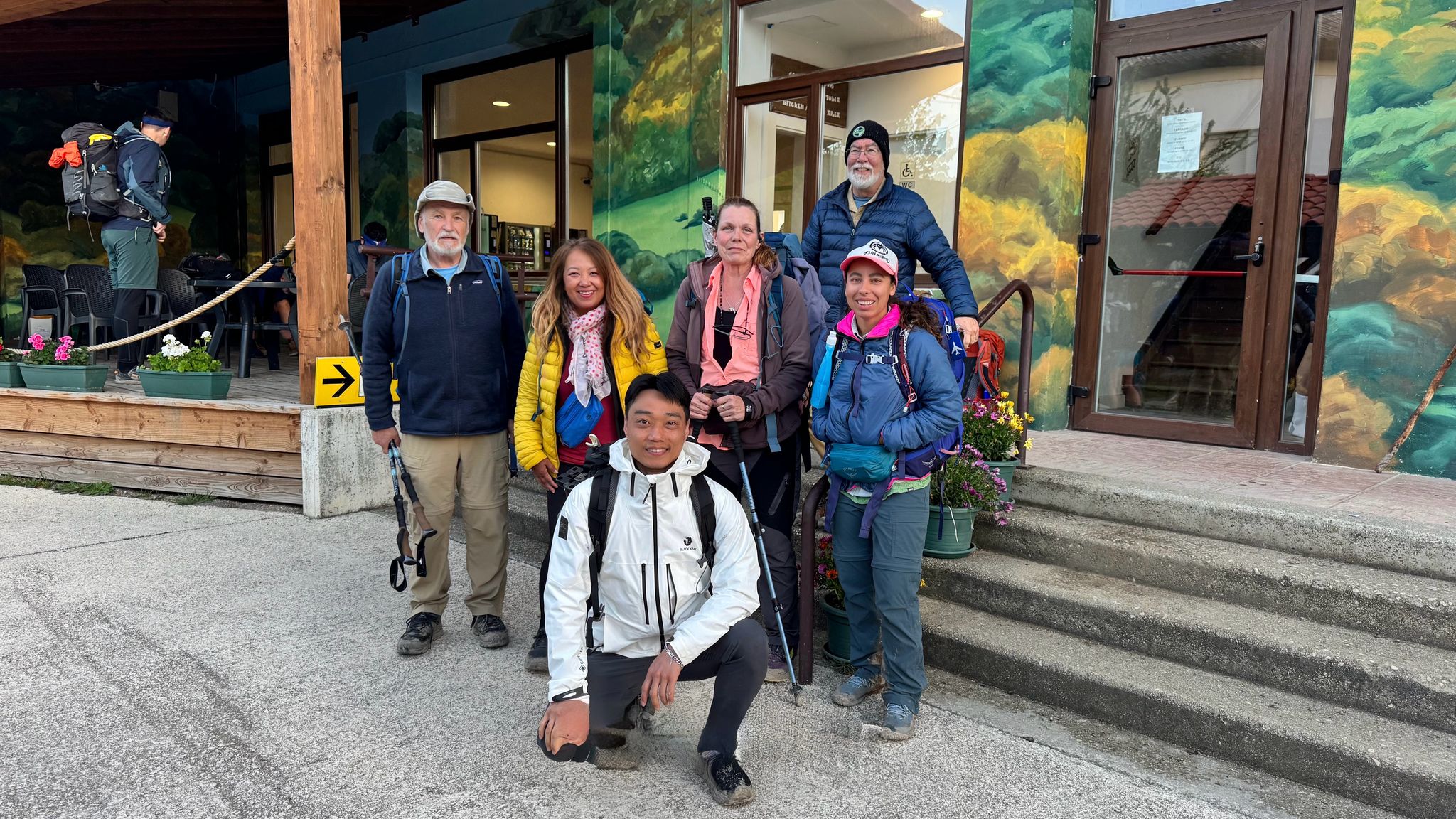
After a (finally) refreshing night’s sleep, I almost forgot how tired I’d been the night before. I skipped breakfast except to scarf down the last of my mom’s scones and blasted off.
This 20 km day followed what would become a familiar pattern: the first 5 km feel so easy that you don’t notice how far you’ve gone, the middle 10 km you remember that you’re on a long pilgrimage and there’s work involved, and the last 5 km—hang on, I don’t want to spoil it. We’ll cross that bridge with our tired feet when we come to it.

For about the first third of the day, I walked on and off with the Camino Repeater brothers Bob and Mark (AKA Mr. Sarcastic) and Kim Kimmy. Bob and Mark explained a lot of basic Camino information to me, the kind of thing most pilgrims probably look up before they start walking. I learned that a lot of pilgrims go by the book—that one I didn’t read—and follow popular/main stages. I’d already hit some of the main stages by following the crowd. If you zoom out from the minutiae of daily stages, there are three commonly recognized abstract or philosophical sections of the Camino Francés as well, each with its own kind of challenge. The first two are the Physical and the Mental. The Physical is obviously the challenge of getting used to walking every day. The Mental begins when you reach the infamous meseta, where the land is flat and empty and many pilgrims become lost in their own thoughts.
They also told me about some popular Camino movies. I didn’t know there were any movies about it, but apparently they’re the reason some pilgrims show up. I promised to check out The Way (starring Martin Sheen), a documentary called Six Ways to Santiago, and a new feature film from Australia called The Way, My Way. I’m sure I’ll get around to watching them eventually.
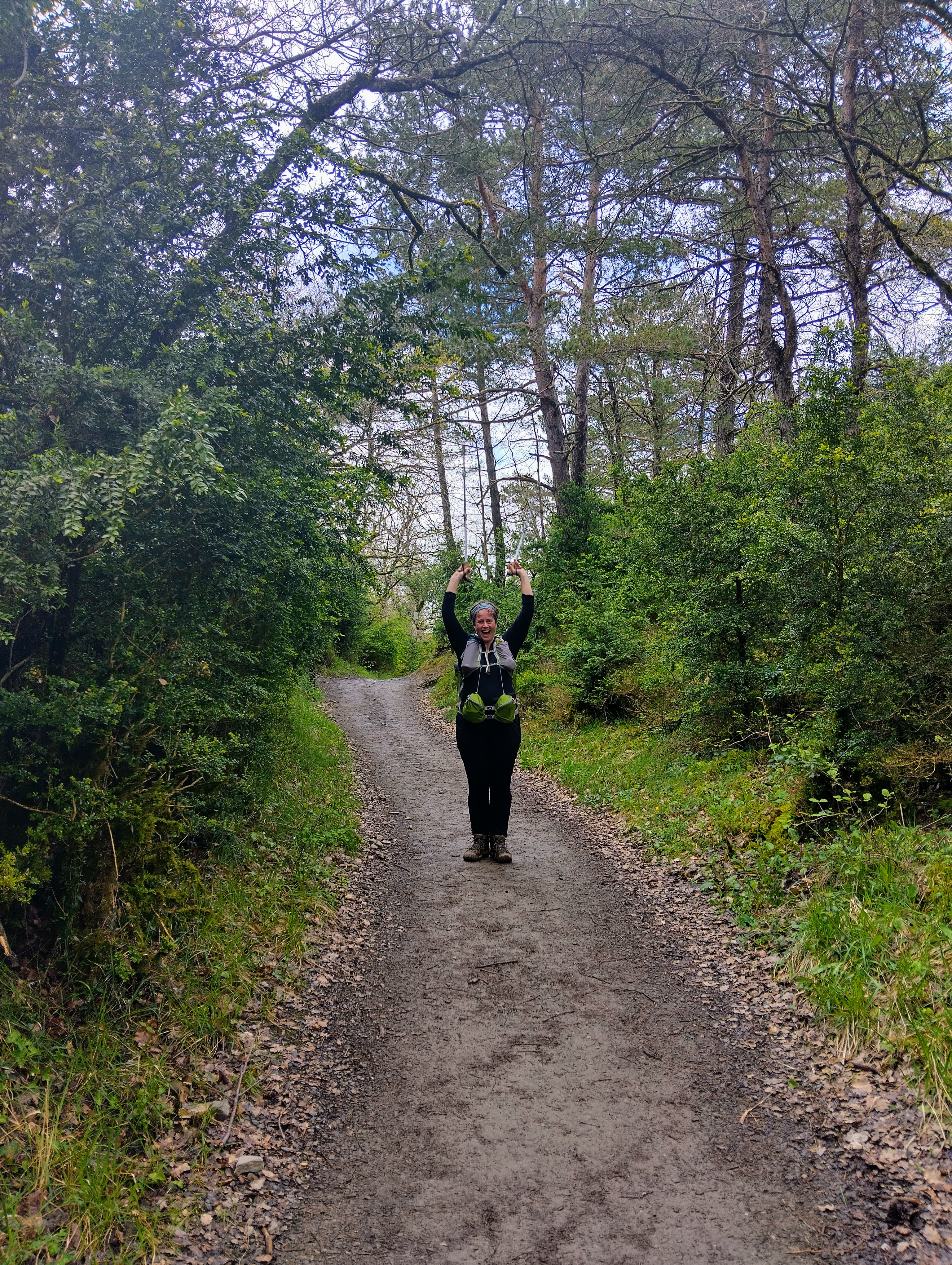
The trail led mostly through forest along the river for a while and was fairly flat, especially compared to the previous day’s descent into Zubiri. The yellow arrows were so frequent that it would seem impossible to go the wrong way, but nonetheless I witnessed a long trail of pilgrims follow each other down a wrong turn. Maybe the first ones to turn down that path did so on purpose to see the town that it led to. I’ll never know, but the ones who followed them seemed to do so absentmindedly, like sheep. It wasn’t as if they were wandering into an abyss from which there was no return, of course. They would certainly figure things out very soon, so I didn’t worry and continued on my merry way.
Just over a little bridge, there was a convenient café where everyone stopped for a bite to eat or a beverage. Alexa and Dana were just leaving as I arrived and other friends were there or just behind. After a glass of fresh zumo de naranja, I didn’t feel much like sitting around though and blasted off again.
The path became awkwardly steep and narrow in small sections. There were bottlenecks of pilgrims taking careful baby steps down concrete ramps. It opened up briefly to curve around a little park next to the river. In that park I saw something extremely rare on the Camino, something I would go weeks without finding another one of: a public bathroom. It was exactly as disgusting as you would expect a park bathroom to be. No toilet seat, no toilet paper, no soap, dirty water covering the floor. One out of ten stars.

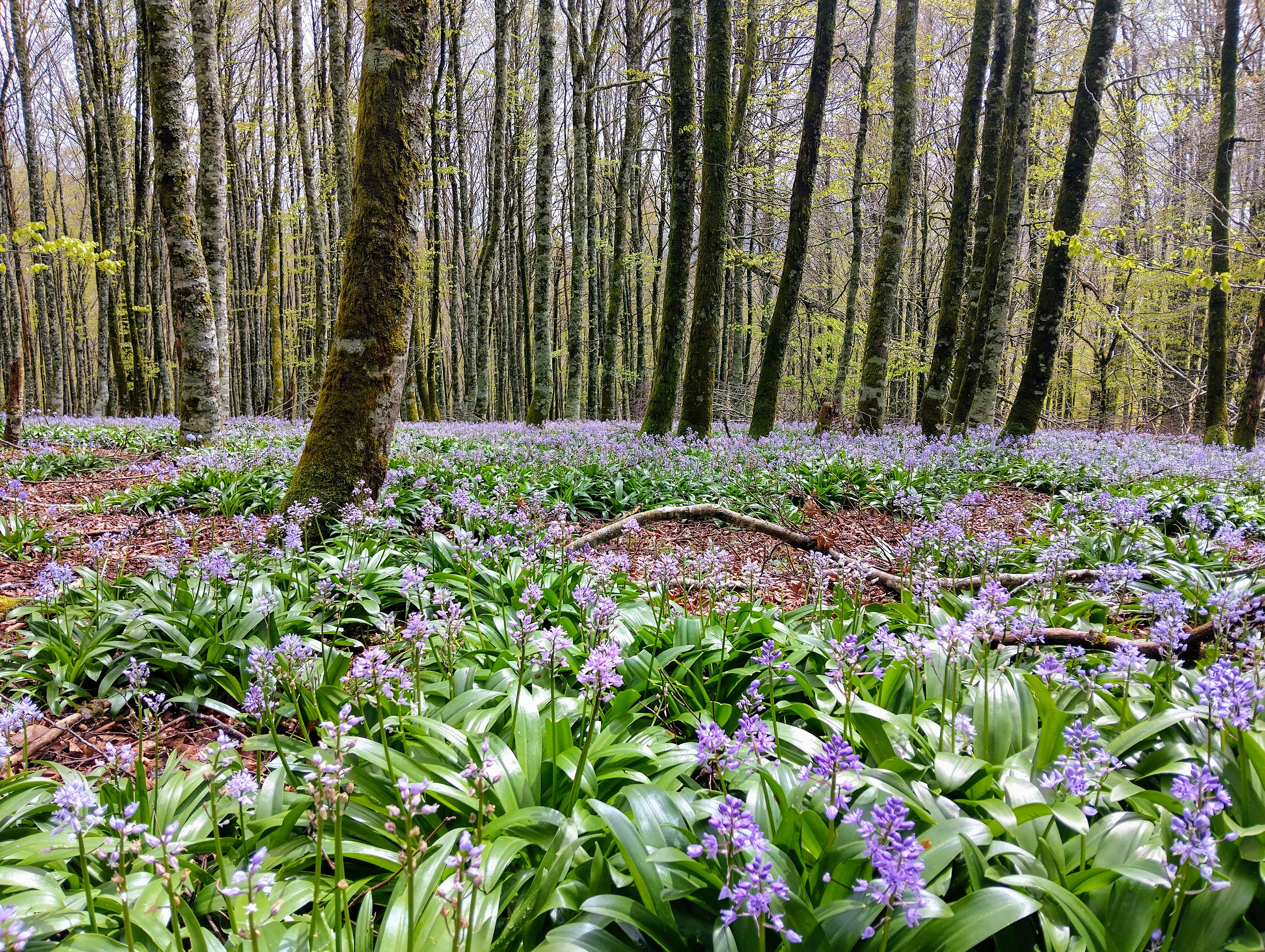
I climbed up through some plants back onto the narrow trail and nearly bumped into Michelle. We went single file along the narrow path between tall grasses dotted with little flowers. Some time later I found Kim Kimmy and we came to a fork in the trail. The left path continued along the river and the right path went through a small town. I could already see Michelle up ahead walking along the river, which was no surprise. I decided to go that way too because I was enjoying the plants and the flowing water. Kim Kimmy opted to go through the town, and shortly after we split I heard the church bell let out a single chime. Kim Kimmy told me later that she got to ring the bell. I can still hardly contain my envy.

But the river path was pretty, and for the first time I saw a field of lush green crops. Then modern civilization started to creep in. The trail went by a major road. I tried to ignore it and instead focused my attention on the surrounding hills. There were a large number of birds of prey circling, using thermals to rise higher and higher. I couldn’t help but think it would be an awesome place to paraglide and felt a little piqued about being stuck on the ground.
The trail went up, overlooking the highway. A local guy was selling fruit out of the back of his car. When he figured out I understood Spanish he roped me into a conversation and showed me Tik Tok videos of himself dancing. He wasn’t good. I bought an orange and finally got away when some other pilgrims came by.
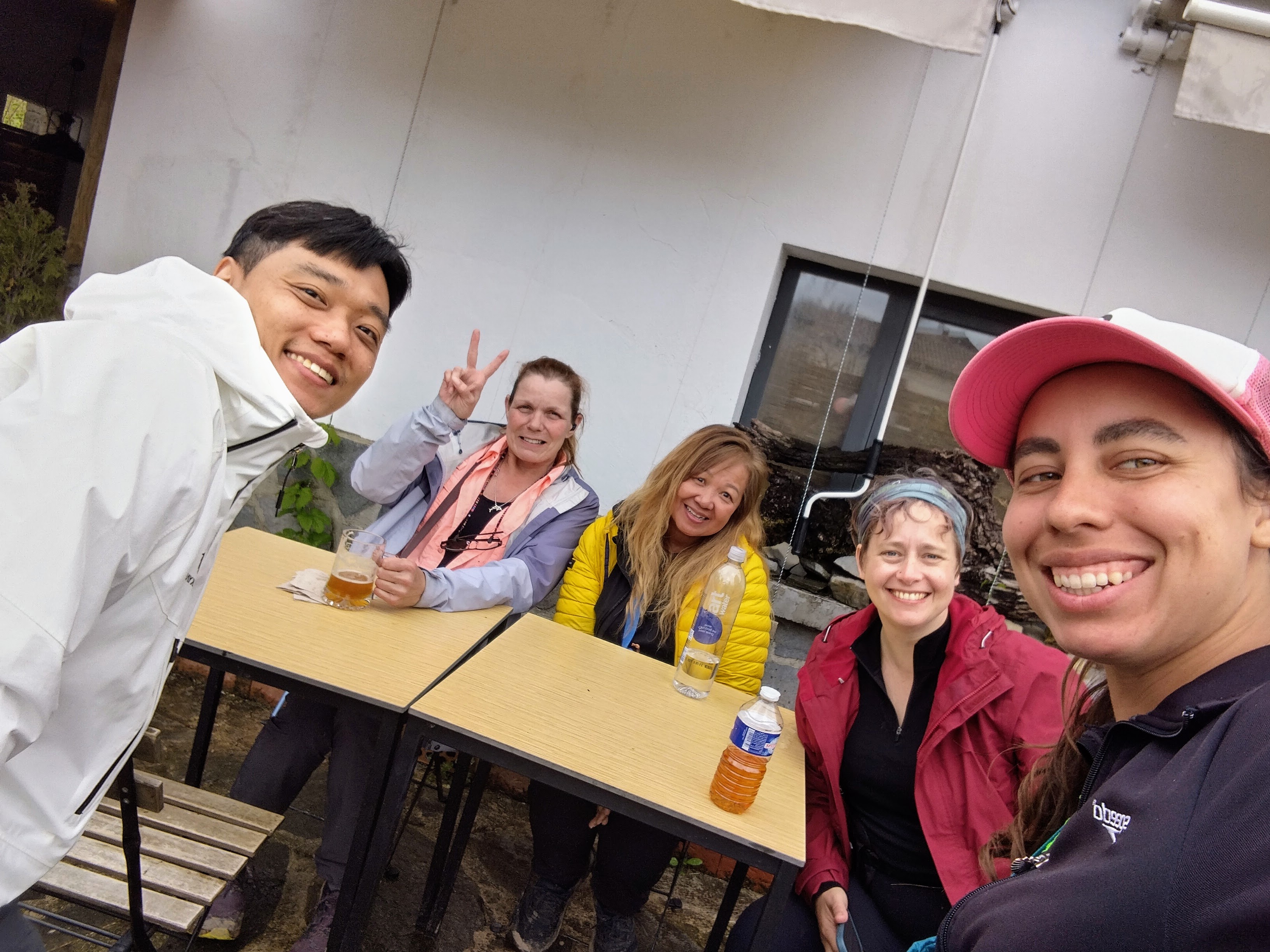
It must have been around the start of the dreaded last 5 km that the trail switched from soft dirt to hard pavement. I stopped at a bridge that led into Trinidad de Arre (which turned out to be the outskirts of Pamplona) to change my socks and found a blister on the bottom of one toe. I shuffled slowly across the bridge and along the cobbled street for only a couple hundred meters before I found friends having lunch. Alexa was there—apparently Dana had decided to take the bus through the city—along with Bob and Mark. I ordered a bocadillo and listened to Bob and Mark regaling a group of pilgrims with tales of the Appalachian Trail.
I still needed more time to rest by the time they were ready to move on. Bob and Mark intended to pass right through Pamplona since they didn’t care for big cities and had been there before anyway. I never saw them again. I didn’t see Alexa or Dana again either, but we kept in touch. They’re both strong, fast hikers who weren’t afraid to take a totally different path if it suited them. I wasn’t alone for long though. Eunseok and Kim Kimmy soon joined me. Kim Kimmy gave me a sheet of moleskin patches for the blister. I tried using one but it didn’t stick for long.
The rest of the walk through the city outskirts was hard because of the pain in my feet and tedious because it was through a modern looking city. Although I didn’t really know where I was going, I assumed that the cathedral would be the natural stopping place. Eunseok and I could see what we thought was the cathedral or a castle on a hill, and when we arrived we expected to enter a large building like we had in Roncesvalles. What we found instead when we passed through the gate was another city—a city frozen in time, at least to my eyes. The walls we’d seen from a distance were not those of the cathedral but the ancient walls of the fortified city of Pamplona. There were cars and electricity and other modern things, but the buildings were older than anything I’d ever seen. In my mind’s eye the cars transformed into carts and horses, the electric lights became burning lanterns, and the people didn’t don modern clothes made of synthetic fabric but medieval tunics, cloaks, and dresses made of wool and linen. Despite my infatuation with the old city—or perhaps because of it—I managed not to take any pictures within the city walls. Hopefully my words have painted at least a partial picture in your mind.

With all this swirling before me, there wasn’t room in my brain to remember that my feet hurt. Eunseok and I veered off the Camino path, which was now marked with metal shells embedded in the cobbled streets, and toured the cathedral. It was beautiful and intricate, though now it blurs together with the other cathedrals I’ve seen since.
We found a cheap albergue near the cathedral which was marked with a large shell hanging out over the street. The bunk beds were partitioned into alcoves of two. Our bunkmates were both starting their Caminos from Pamplona. One was a Spaniard whose pack weighed a whopping 22 kg. He was already taking things out to mail home. The other was a South Korean man with all brand new gear in matching mint green who hadn’t done any walking before, not even to break in his new shoes. They were both amiable characters, and while neither spoke each other’s language or very much English, they were very keen to have a conversation. It was a four-way roommate match in heaven. The Spaniard told me in Spanish what he wanted to say, I translated into English for Eunseok, he translated into Korean for the Korean man, he replied in Korean, and we went back the other way. The Spaniard was genuinely concerned for the enthusiastic but physically unprepared Korean. He showed him how to adjust the straps on his backpack and gave advice for taking care of his feet. The Korean fellow—I say fellow because it really feels like the right word for him—was simply delighted to be a pilgrim and laughed out loud when he explained that his family didn’t believe that he could do it. He gave each of us some little things; I got a little bar of soap and a net bag to put it in. I felt like I had to give him something in return. I knew he didn’t have a cord to tie his poncho, so I hastily gave him mine. In retrospect, I shouldn’t have done that, because I needed it myself.
I took a half-decent shower in the co-ed bathroom, which thankfully had the luxury of stall doors that closed, and put on my town clothes, orange toe socks and all. Eunseok and I had arranged to meet Kim Kimmy at the town hall for a walking tour. That’s right, a walking tour, because we hadn’t done enough of that already. We saw the old keys that opened the gate for the running of the bulls, old cannon balls that the neighborhoods used to fight each other in medieval times, and the other major churches. The tour concluded with a little prayer meeting in which everyone introduced themselves and shared their reasons for doing the Camino. There were three guides who translated between Spanish, French, and English in a telephone game fashion like we’d done at the albergue earlier. Afterwards everyone went to mass, which was ok by me because we got to sit for at least some of the time.
If you thought we couldn’t possibly do any more extra walking that day, you’d be wrong. Eunseok needed a pair of shower shoes and I went with him to help communicate. We found ourselves on the opposite side of the old city center from where we’d come in. The narrow streets and stone four story buildings suddenly gave way to a wide boulevard and modern cement towers, which shook my brain out of its medieval fantasy.
Once the shower shoes were obtained, it was time for dinner. Up until now on the Camino there had never been more than one option—now there were restaurants everywhere. We had tapas with a nice couple from London and then went for churros con chocolate. They’re different from what you would find in the US or Mexico. The churros are small and teardrop shaped and you dip them in a huge cup of melted chocolate. Halfway through our second order of churros we found ourselves fading fast and realized it was past 9:00 pm. I still hadn’t gotten the hang of the late daylight hours.
We’d been warned that the albergue doors would be locked at 10:00 pm. This would have been plenty of time if either of us could remember our way back or even the name of the albergue. We wandered the streets in the dimming light looking for something familiar, but it was all familiar—all the streets looked the same. Eventually we found the Camino path and followed it backwards to where we’d first turned off towards the cathedral. At 9:50 we found Michelle outside a restaurant enjoying a glass of wine, and just up the street was the hanging shell that marked our albergue. Some weeks later, I would realize that this night was the only night of my Camino that I was out after dark. I wasn’t worried about missing that little hour of sleep though, because Michelle, Eunseok, and I had decided to stay in Pamplona for a “rest day”.
Day 5: Pamplona
The intended rest day wasn’t very restful. With very few exceptions, albergues don’t allow pilgrims to stay more than one night and they require everyone to be out usually by 8:00 or 8:30 am. Eunseok and I got up early and managed to do some rushed laundry, but the dryer wasn’t working properly, so I ended up with wet socks to carry—again.
Outside, the city was no longer the bustling hive of energy it had been the previous evening. The streets were deserted except for a few delivery men and nothing was open except for pharmacies and the odd café. The Spanish like to stay up late and sleep in, so most businesses don’t open until 10:00 or 11:00 am. Then everyone takes a siesta in the afternoon, so they close again from 2:00 to 4:00 pm. Hustle culture just isn’t a thing.
Michelle was staying at a different albergue, so we went there to meet her. It was easy to find because it was on the Camino path. There was nothing to do other than wait around in the lobby. I felt a cold coming on, so I left my bag with them and went to find a pharmacy.
Luckily for me (and most people, I imagine), the pharmacies do have longer hours, except on Sundays. I got some zinc to boost my immune system. On my way back, I saw two people waving to me through a café window. I recognized them from Orisson! It was Fiona and Evannah, a mother and daughter from Australia. Evannah had just graduated from secondary school before they came to walk the Camino together. I went in to say hello and hear about what they’d been up to. They told me about the albergue they’d stayed in the previous night. It was a donativo (payment by donation only) attached to a convent and run by volunteers. Listening to their descriptions of the amazing experience, I immediately felt drawn to stay there myself. It’s not advertised, and as far as I can tell, everyone who stayed there find out about it by word of mouth. My friends gave me a paper map and directions of how to find the convent and the albergue entrance. Apparently, they had mistakenly knocked on the door of the convent itself, which is inhabited by cloistered nuns who interact very little with the outside world. But a nun did answer and pointed them to the albergue door. I can imagine her shyly peeking out, wondering what was going on.
I said “hasta luego” to Fiona and Evannah and went to tell Eunseok and Michelle that we’d have somewhere nice to sleep that night. They liked the sound of the place too, and besides we’d overstayed our welcome in that lobby and were getting kicked out. Check-in at the convent wouldn’t be until 1:00 pm, so there was plenty of time to kill. While Michelle took care of some personal errands, Eunseok and I explored the city walls, a museum about the festival of the running of the bulls, and the pilgrim office. The pilgrim office was showing a really cool video about Pamplona. One of the things I learned was that, for centuries in Pamplona, it was illegal to build outside of the fortified city walls. Before the law was changed, they built up instead of out. That explained the dramatic difference between the old city center and the more modern outer city. I told Eunseok about it later because he fell asleep through the video.
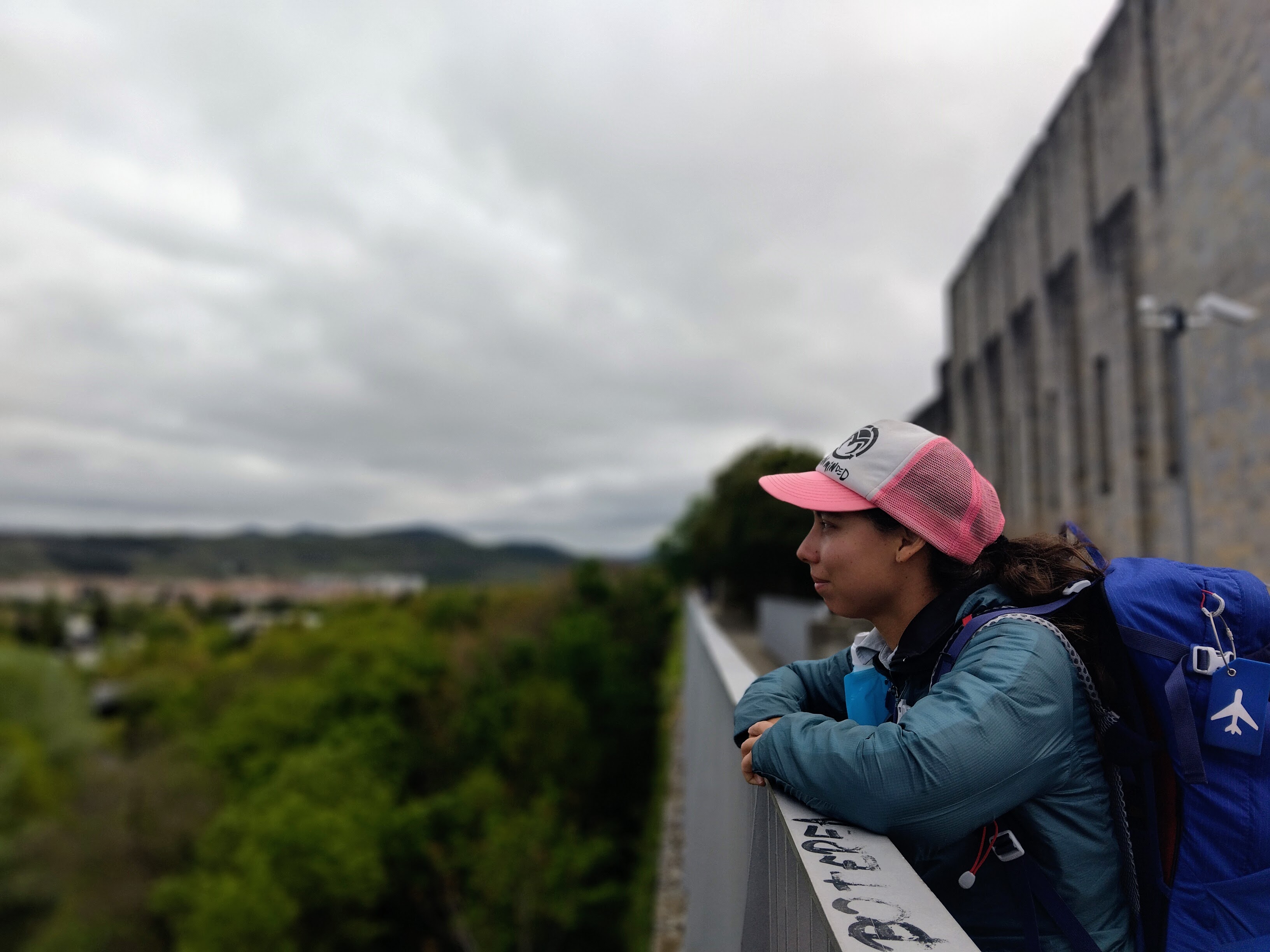
At check-in time, we met Michelle at the convent. There was another pilgrim there already, Johnny from New Jersey, and we were all given the grand tour together by the volunteers. We learned that the volunteers stay for two weeks before either moving to another donativo, continuing their own Caminos, or going home. Our volunteers were two amazing ladies named Rosa and Margaret, from Florida and Australia, respectively. They’d each done about 25 Caminos in the last 10-12 years! The place itself was also absolutely lovely. I was even able to hang my socks to dry in front of a lovely window with a nice view of tree leaves and flowers, all of which I could see from my bed.

Once we were settled in, I basically dragged everyone, including Johnny, to the restaurant that Ernest Hemmingway famously used to hang out in. I’m not a huge Hemmingway enthusiast (more of a Jane Austen kind of gal), but I’d read a few of his books. Johnny had read more and actually remembered the plots, whereas I could barely remember the titles. Luckily for me there’s no quiz to get into the restaurant. The place was much larger than I expected, but exactly as art deco. The food was overpriced and not good; I had a steak which was very overcooked.
Then everyone went separate ways to run errands or rest. My dad and sister had specifically requested that I pick them up some botas, or wineskins. After a lot of searching, I found them in a store on the street where the bulls run. On the way back I got lost again. I felt better about it later when Eunseok told me he got lost too.
The vibe back at the donativo was amazing. More pilgrims had arrived and were relaxing. They don’t have Wi-Fi, so pilgrims are forced to resort to old-fashioned entertainment such as talking to one another, or playing live music on the piano or guitar in the common area. I cozied up with some soothing apple tea made by Rosa using apples from the nun’s orchard, and listened to Anastasia from Berlin play the piano beautifully. She’s a legitimate concert pianist and a really cool person.

Rosa and Margaret cooked a delicious dinner using more of the apples that the nuns gave them. The comradery around the table was fun and energizing. Eunseok got another new name: Santiago, which is Spanish for Jacob.
After dinner there was a special treat. We were led down to a private chapel that is only open to pilgrims who stay in the albergue. I didn’t expect much, maybe a room with a little altar and candles. We went downstairs to the basement and—holy cow! (Yes, I did write “holy cow” in my journal.) It was a room as large as the churches that I’d toured with a huge Baroque altarpiece that was more intricate than the cathedral. I think the unexpectedness of finding something so elaborate in a dark basement that’s closed to the public made it more sensational. Nothing that one goes to see is ever as beautiful as something that one finds by accident.
Rosa read a statement from a priest who is usually there and we sat for 20 minutes of silent contemplation. I found myself thinking about the limitations of peoples’ perceptions of each other. We meet someone and decide what kind of person they are based on very little information and they do the same with us, but with limited knowledge of each other it’s impossible to get a complete idea of who someone really is. I wished I could see myself from the outside to see how I am perceived and why it often seems so different from who I think I am and who I want to be. Tears rolled down my cheeks. When we went back upstairs everyone went to their own spaces for a while. I asked Rosa for some more tea (I couldn’t get enough of her apple tea) and sat in the empty common area. Rosa saw that something was bothering me and sat with me. She asked me about myself and I couldn’t help but cry again. Then she did something that most people don’t do. She talked to me without trying to tell me what to do. She told me about “the tap”, a concept she’d read about. It’s when someone metaphorically taps you on the shoulder with an opportunity for something you never would have considered otherwise. I felt a little better.
After a while the others came back to hang out in the common area. Jack from London taught me a little tune on the piano which was fun. When Anastasia came back she played a beautiful song for everyone. It got surprisingly late, and even though we were all exhausted, we were enjoying spending time together too much to want to go to bed. Rosa put her foot down for bedtime of course. I went to sleep thankful to be in such a beautiful place and felt that I would think a lot about who I want to be when I started walking again tomorrow.








 Victoria Castillo