
The next five days were a little rough (for reasons that will become clear) and my journal entries left a lot to be desired in the way of detail. I’ve done some detective work to try and make up for it. By going through photos, WhatsApp messages, and Mark’s great vlog posts, I’ve been able to jog my memory and fill in some of the gaps.
Day 11: Viana → Navarrete (21.51 km)
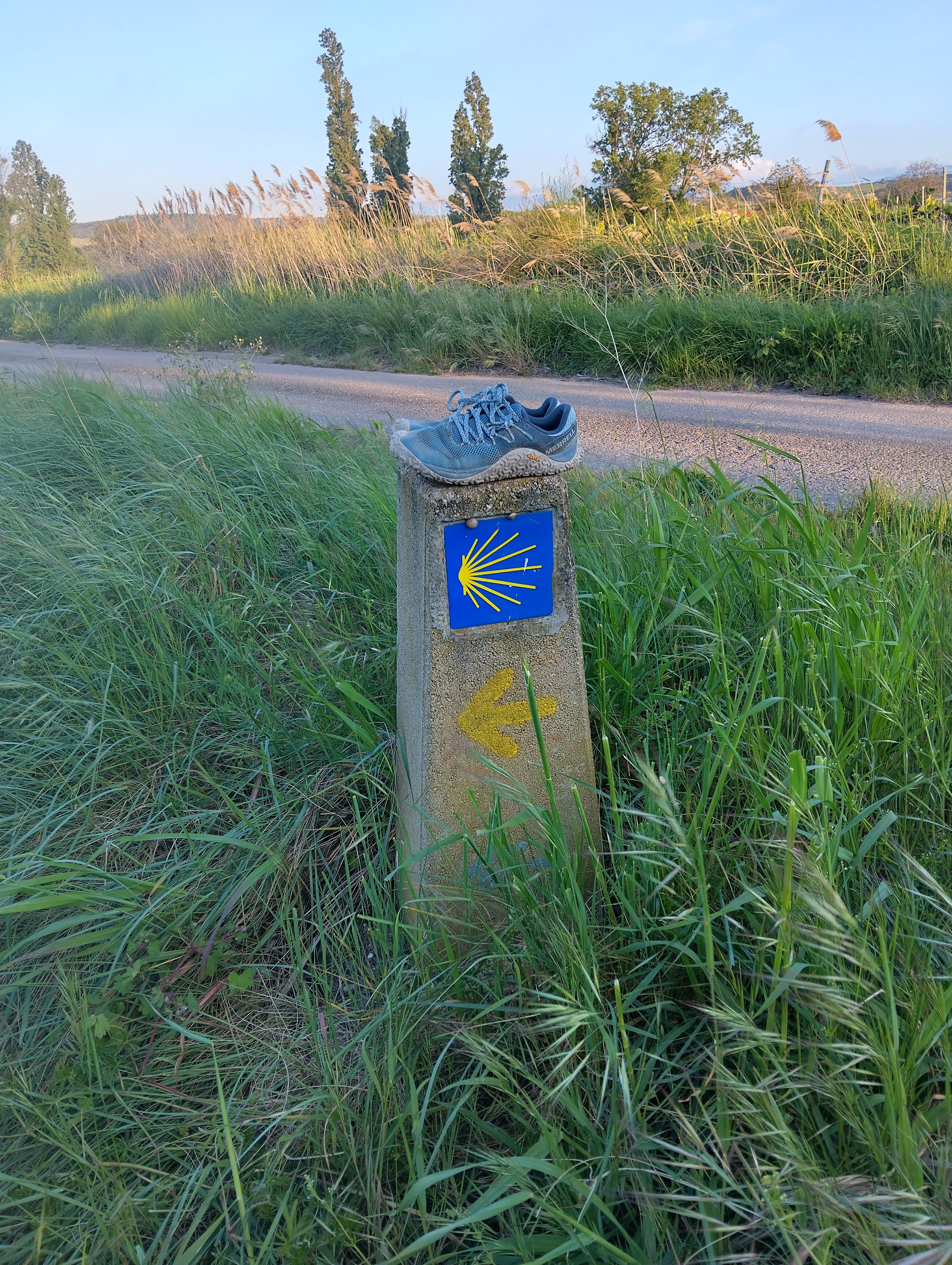
I didn’t know for sure, but I had a funny feeling in the morning that there was going to be a lot of road walking coming up. There was. The arc of the walking day continued along the same pattern: the first 5 km are easy, the middle 10 km you start to feel it, the last 5 km are torture. My feet were in such a state that I couldn’t bear the thought of putting close-toed shoes on, so I hiked the whole way in toe socks and sandals. I still developed blisters between my toes—on both feet now.
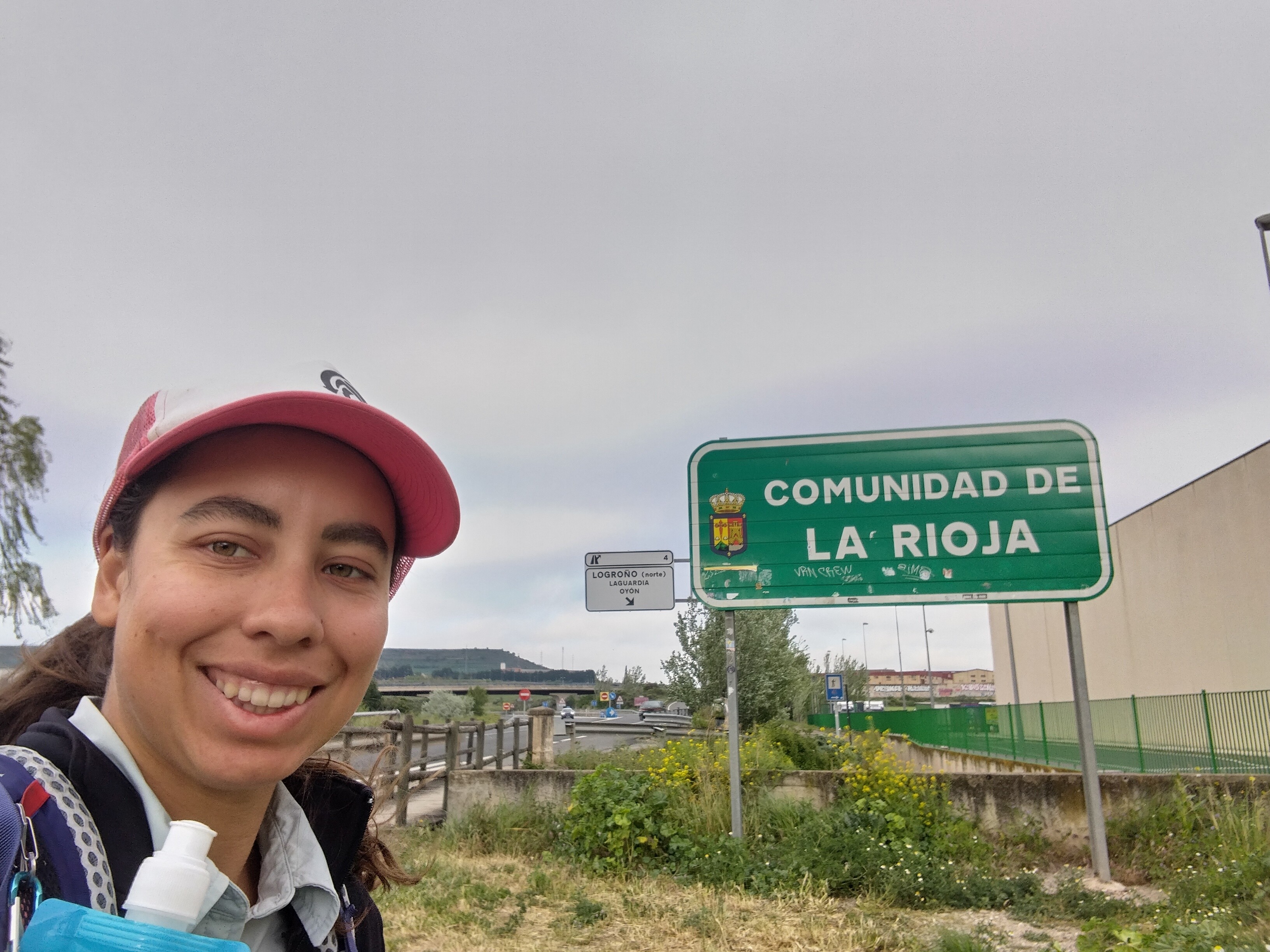
The Camino left the fairytale region that is Navarra and entered the wine country of La Rioja. All of the small towns so far seemed to be populated solely by the elderly, and I had begun to wonder where all the young people were. Turns out they were in the city of Logroño. It seemed like a more modern city compared to Pamplona, my only point of comparison. It was far too early to stop for the day, so I had some breakfast (napolitana and Colacao), grabbed a sandwich para llevar (to-go), and traversed the whole city. The path went through a really long park which was pleasant to walk through and alive with locals, but notably devoid of public restrooms.

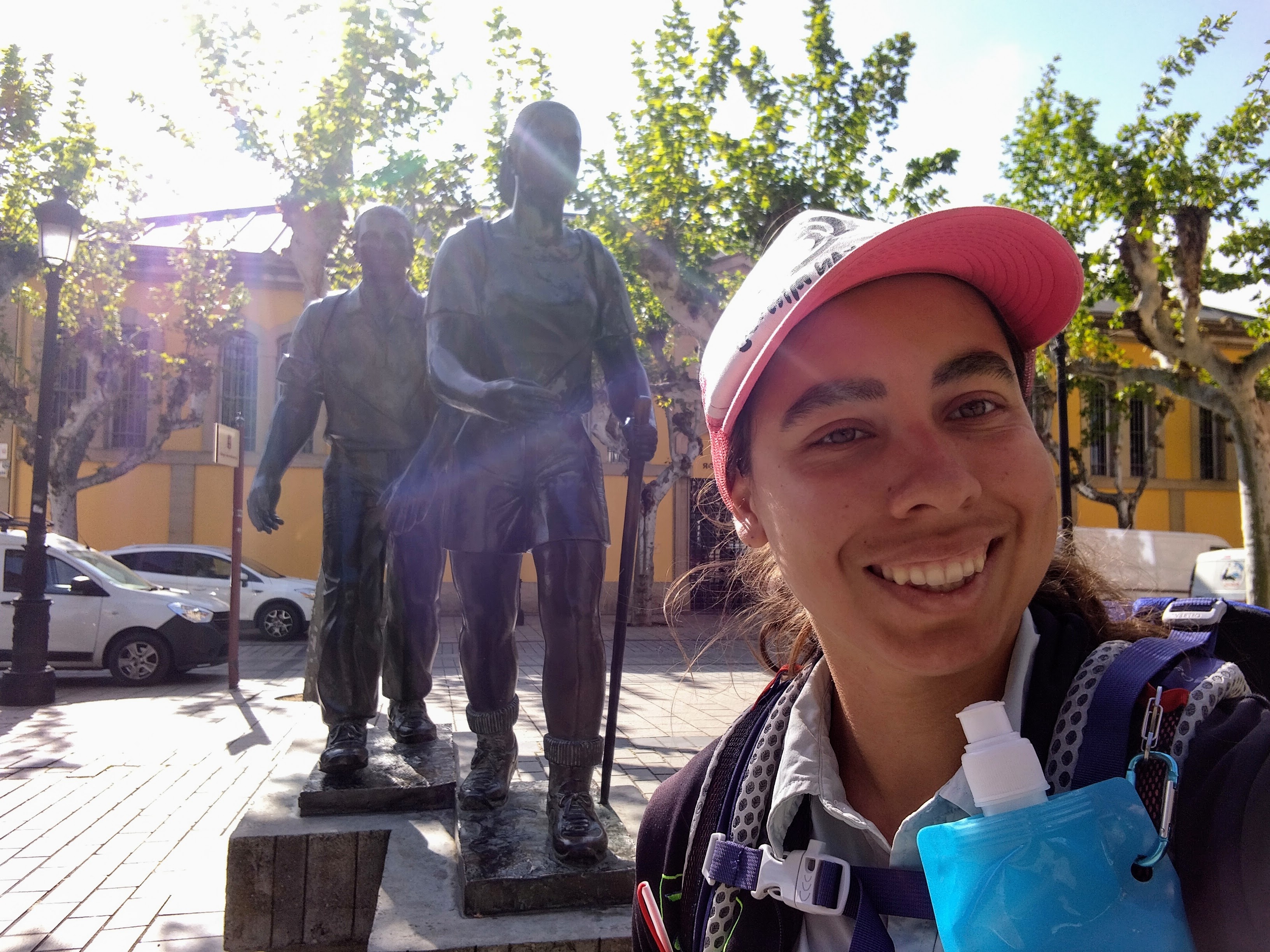
Outside of the city, I walked with Teresa and Archer for a while. When I noticed Archer taking a drink from his water bladder, I suddenly remembered that I had found a magnet that looked like the one used to attach the tube to his bag. I couldn’t recall even at the time when I’d found it—it might have been sometime in between when I first heard the cuckoo bird and when I made my emergency sprint into the woods. Anyway, I remembered that I had it and asked if they’d lost theirs. Sure enough they had, so I returned it to them. I’m not sure “the Camino provides” is quite applicable in this scenario, but maybe we can call it part of the “Camino traveling lost and found”.
We crossed a river where people were fishing off a bridge. A little further down in a no-fishing area, we found all the fish. They were aware of us and came right to the surface, sticking their gaping mouths out of the water in our direction. They must have picked up this behavior from people feeding them.
By the time I reached Navarrete my feet were barely functional again, so I checked in to the first albergue I saw. Unfortunately it had a lot of stairs. The only other pilgrims there were a couple of French ladies. One of them saw me hobbling around so pathetically that she insisted on rubbing essential oils on my legs. I’m not sure exactly what it was because she only spoke French and a little Spanish.
After an adequate shower, I went to see the town and buy some soap. I might have enjoyed it more if my feet had been in better shape and/or the town wasn’t so slanted. There wasn’t much going on and it was very cold outside, so once I’d found the soap, I spent some time engaging in my new favorite hobby: sitting in a café drinking Colacao.
A big group arranged to have dinner together. It was the restaurant’s first opening in six months (some businesses along the Camino are only open during peak pilgrimage season) and we filled up half the place. The owner was a very nice lady who didn’t speak any English, so I got to be especially useful translating. I should have gotten the steak instead of the fish, but overall the food was good and we had a fun time. The owner absolutely adored Archer, who was super excited for each course. I think he made her day.

Sarah, Emma, Andrew, and Gillian very nicely walked me all the way back to my albergue. They’re the most cheerful family, and never rushed or worried about anything at all as far as I could tell. The French ladies were already asleep and it looked like no one else had arrived while I was out. I got ready for bed as quietly as possible and hoped my feet would start to get better soon.
Day 12: Navarrete → Nájera (16.03 km)
Here’s where I really have to dig for details. My journal entry for this day says this:
“Terrible day. Painful blisters between my toes, very sore, scenery bleh. Barely made municipal due to holiday. Cried. Have a cold. Bus tomorrow.”
What really happened was that I had a terrible day because of the blisters between my toes, got very sore, the scenery was probably fine, and I couldn’t find the municipal albergue for about an hour because I was lost in a daze in a medieval fair. Throughout all this I could feel myself getting sicker and sicker and I wasn’t the only one. Something—possibly more than one something—was going around among the pilgrims.
I do remember that the town was nestled among red rock formations that reminded me of New Mexico. The air was saturated with the aroma of food being sold from booths by locals in medieval costumes. Other booths had things for sale and games, and there were so many people that at more than one point I was only able to make my way through the dense crowd by following closely behind a line of ponies carrying small children.
When I finally made it to the municipal albergue, I waited in line with Kim Kimmy and Eunseok. It was the cheapest albergue (though not the worst quality) that I stayed in on the whole Camino at 6 euros. I begged the young American hospitalero for a bottom bunk and promptly passed out on it. Later I would get to enjoy Kim Kimmy’s impression of my insensible, zombie-like condition.
Day 13: Nájera → Santo Domingo de la Calzada (20.93 km)
I slept for 11 hours and felt sick in the morning. I went straight to the bus station. In Santo Domingo I bumped into the exuberant Dutch lady who’d been in the donativo in Estella. She gave me a piece of chocolate which revived me just enough for the walk to the city center. I waited around in a very low vibe café near the cathedral for albergues to open and friends to arrive. It started raining. I ate more than one breakfast of tortilla and zumo de naranja to avoid going outside. Michelle and Eunseok arrived and I had another breakfast with them. Somehow I was still hungry.
Eunseok tried to help me find a private room so I could recuperate, but we didn’t have any luck. I should have gone to the municipal with them but I was too tired to think, so I ended up in a cold, drafty convent-turned-albergue with no ladders on the bunk beds and stone floors that reminded me of the Dragon’s Teeth. The woman running the place insisted I had to have a top bunk because the bottom ones were all reserved. I rested on an open bottom bunk in the meantime; I wasn’t going to climb up to the top until I was ready to sleep for the night.
The rain turned into a thunderstorm and I was relieved not to be walking in it. Many other pilgrims got caught in it and took shelter in small cafés and under highway overpasses. When it let up, I went out with Michelle and Eunseok again and had a big lunch. Evidently my body needed fuel. I may have forgotten to eat the day before.
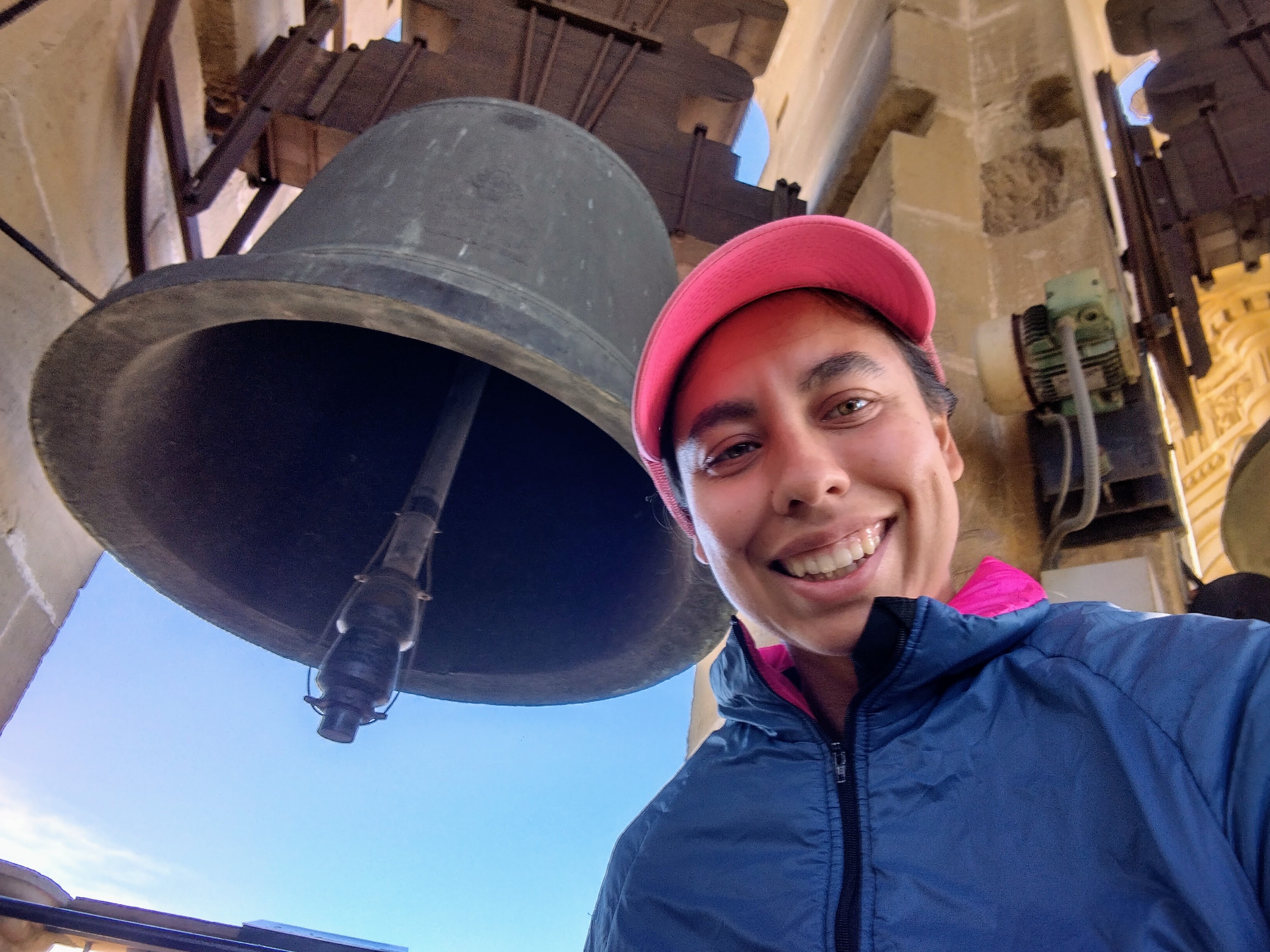
Michelle was developing a nasty cough so she went to rest while Eunseok and I toured the cathedral. It was very chicken themed. The explanation for this was considered so obvious that there was no sign explaining why. I learned from another pilgrim that Saint Dominic (Santo Domingo) is famous for a miracle in which a dead and cooked rooster and hen were brought back to life. Another notable thing about this cathedral that differentiates it from others is that the bell tower is unattached to the rest of the building and you can go up into it. I ran into Kim Kimmy on the way to the tower and we ascended the narrow, spiraling staircase together, trying to figure out the mechanism for the clock as we went. We passed a dead bird who must have flown in and gotten injured. On our way back down a man was trying to pick it up—he was using a bag or something to avoid touching it directly—and it moved. It wasn’t dead after all. He brought it down under the careful supervision of his young daughter and released it in the courtyard.
I went back to the albergue for a late siesta and the supposedly reserved bottom bunks were still open. I’d seen these kinds of reservations given away by late afternoon, so I asked if I could take one. I was told they were going to hold them until 7:30 pm. Thus began what I like to call The Siege of the Bottom Bunk. With the moral support of my fellow bunkmates, I put my sleeping bag on a bottom bunk, messaged my friends that I would be late for dinner, and napped. At 7:30 on the dot I transferred my disposable sheet and officially declared the bottom bunk to be the captured territory of the state of Victoria.
It started raining again, but luckily dinner was very close by. I stuffed myself with soup, pasta, and flan, because apparently three breakfasts and a large lunch hadn’t been enough, and listened to my friend’s stories of the day. Teresa and Archer had narrowly avoided the thunderstorm by finding shelter in a little town on the way.

It was a cold night in that old convent, and somehow windy inside with the windows closed. I curled up tight in my sleeping bag and I imagined it was the ghosts of nuns drifting around.
Day 14: Santo Domingo de la Calzada → Castildelgado (12.48 km)
In the morning I still had a bit of a cold but felt well enough to walk. I stuffed my pockets with toilet paper and hoped for the best.
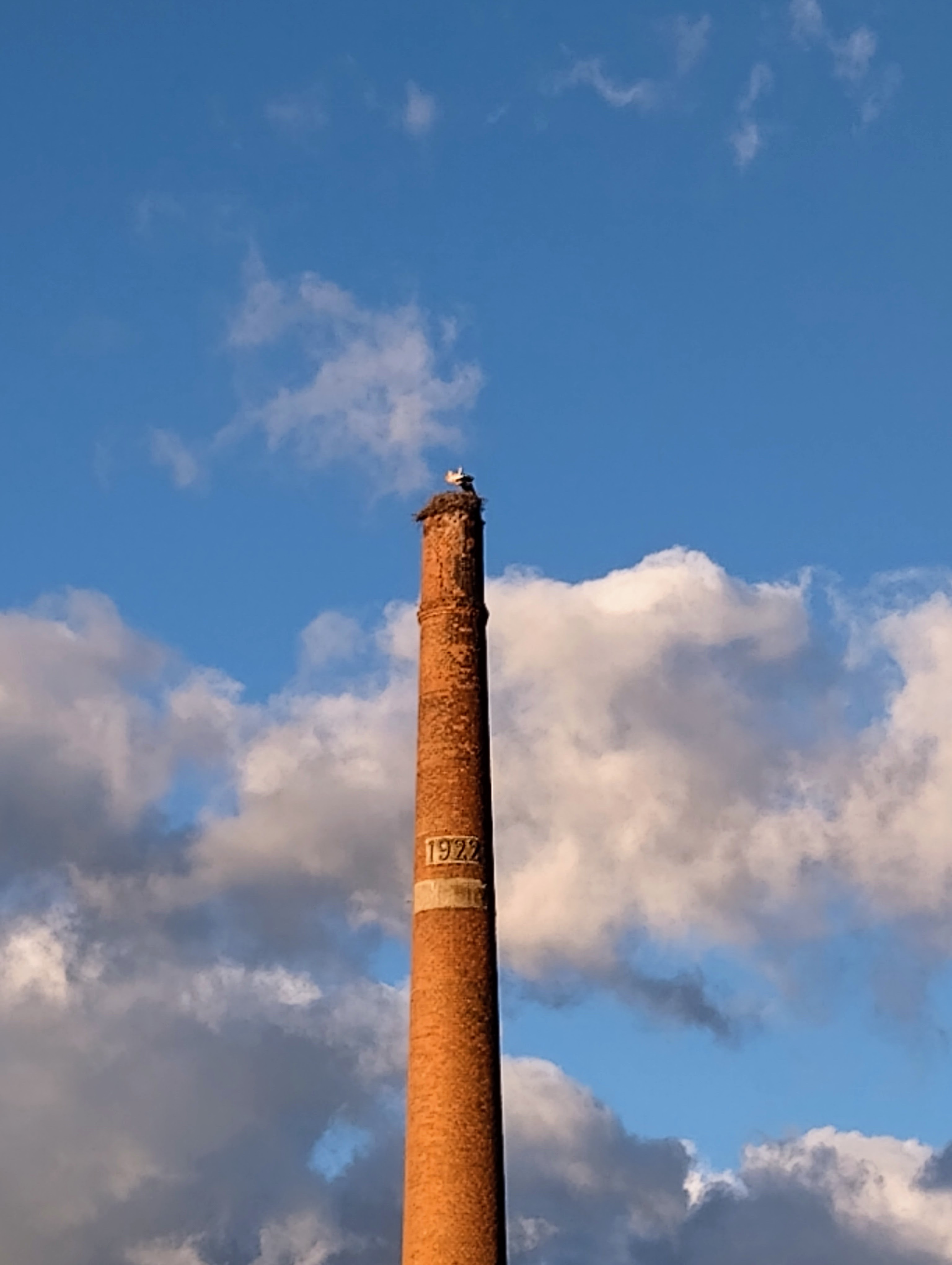
Outside of the town there were some smokestacks on top of which I saw the first storks. From this point forward through Castilla y León, on top of almost every smokestack or church tower, or any other tall structure with a flat top, there were stork nests.
A short way up the trail there was a hill and I noticed pilgrims ahead of me turning around to take pictures. I turned to see hot air balloons rising in the cool morning air.

As I went over the hump of the hill, an incredibly rapid mist came in and the view of distant fields that was visible only a minute before was completely enveloped in whiteness. By the time I reached the bottom of the hill, the mist vanished almost as quickly as it had come and left a “white rainbow” (or halo) shining in the warm sun.

Most everyone stopped for breakfast at a food cart in the town of Grañón. Many friends were already there or arrived shortly after I did. There was a long but fairly quick-moving line and I chatted with Michelle while we waited. When I got to the front, I opened my mouth to order and was suddenly interrupted by the man behind me literally ordering over my head. I was dumbfounded for a second before someone took over to defend me. That someone was my previously unknown alter ego, Spanish Victoria. Spanish Victoria did what English speaking Victoria couldn’t do and resolutely declared that she was at the head of the line. The man apologized and made lame excuses for himself. Spanish Victoria ordered breakfast and washed her hands of him.

I continued walking, hoping Spanish Victoria would stick with me. The Camino left La Rioja behind and entered another new region, Castilla y León. The province is actually a combination of the two regions: Castilla + León = Junta de Castilla y León. First up was Castilla, land of my ancestors.

I don’t know anything about the politics of the region (or Spain, or Europe for that matter), but apparently not everyone wants to be junta. Almost every sign was graffitied to cross out León. Later, in León they had crossed out Castilla.

My blisters felt ok until what was to be the last kilometer of the day. Kim Kimmy was planning on staying at a little albergue off the main stages and my feet insisted that I join her.

It was a beautiful, immaculately clean albergue. The shower was heaven; I washed my hair for the first time since Pamplona. After hand washing our laundry, Kim Kimmy and I relaxed in the backyard for a while. Then there was a communal dinner (probably chicken and vegetable soup). The only two other pilgrims were guys, so Kim Kimmy and I got a whole bedroom to ourselves. I slept very well that night.

Day 15: Castildelgado → Villambistia (16.95 km)
The albergue served breakfast in the morning and then we were unceremoniously rushed out. I walked on and off with one of the guys we met at the albergue (unfortunately I can’t remember his name). He was in bad shape too, with shin splints.
I stopped to rest and eat breakfast in Belorado, where most of my friends had gone the day before. The streets had hand and footprints of people who I presumed were from the town.

The rest of the walk is pretty fuzzy in my memory. The blisters got worse despite my frequent stops to reapply vaseline or bandages. At one point some Spanish pilgrims passed me and one of them mistook me for a Castillian and told me my accent was very convincing. I was incredibly pleased with myself for that and regained some pep in my step for a few hundred meters.
But a few hundred meters was about all I could manage at that point. When I hit the small town of Villambistia, I checked the Buen Camino app (that’s right I finally used it) and saw that the next town was only 1.5 km further. But I couldn’t do it. I shuffled into the municipal albergue and called it for the day. I was in the middle of nowhere, off-stage, sans-amigos because I couldn’t continue through the pain.
 Victoria Castillo