Tag: cathedral

  • Camino de Santiago – Days 26-27: El Burgo Ranero to León

    Oops, I forgot to mention something funny that happened while I was scarfing down that chicken at the end of the last post. Luckily no one is grading this and I have full creative control, so I’ll just write it here. This little anecdote is about Kim Kimmy and her achievement of Camino celebrity status. She had been writing daily summaries and posting them on Facebook as she went along. Apparently a lot of other pilgrims were reading her posts every day. While I had my face buried in my food, a couple of such pilgrims approached our table and asked to get a picture with her. They said “they felt like they were walking with her”, which was silly because they really were!

    Day 26: El Burgo Ranero → León (37.29 km)

    I woke up determined to take whatever means necessary (other than walking, obviously) to get to the city. Although my blisters were no longer painful, my shins felt like they were splintering into tiny pieces with every weighted step. My phone was dead and my charger was broken, which is to say civilization had collapsed and I had no means to look up transportation options. As far as I could tell, the restaurant we had eaten at the night before was the only business likely to be open, so I went straight there to look for information.

    They were very helpful with giving me the train time and directions to the station. I ate a little breakfast while I was there and noticed how happy the people working here were. They were local Spanish people, not temporary employees from abroad like in some places. But they were not dead-eyed and miserable like so many locals I had seen. The girl behind the bar was cheerful and cracked jokes with the pilgrims. Even though she spoke only Spanish and not everyone understood what she said, they laughed anyway and everyone had fun. It was hard for me to understand how they could be so happy in what I saw as such a miserable place. My favorite ancient dead guy, Epictetus, said,

    “Men are disturbed not by things, but by the views which they take of things.”

    This may not be a difficult thing to understand, but it is an almost impossible one to live your life by. In my physical pain I wandered into this town, and I viewed it as ugly, like a decaying truck stop in the boonies of America, and I became more miserable than I would have had I arrived in the same condition to a mountain cabin or a seaside resort. But the people living here weren’t miserable, so was it really ugly?

    Despite the depth of my existential impressions of the place, I was only actually in the café/bar for ten or fifteen minutes before I had to catch the train, which was due to arrive within minutes. The directions to get there were simple, it was almost a straight line, but there were no signs. I diligently followed the route I had been told into an industrial area, encouraged only by the view of tracks converging in the distance. It felt much further away than had been described and I got more and more stressed that I might miss the train. My steps were already as fast as I could manage, and had the train suddenly pulled in, I could not have run to catch it. The road came to an end near a closed, abandoned looking building. I went around the outside and found the platform, where three or four pilgrims were already waiting. This was the greatest possible relief imaginable. Even if we all missed the train, at least we would be miserable together. We did not miss the train, however; it was only a few minutes late. I bought my ticket from the conductor for €1.85 and was actually short 5 cents, but he told me without hesitation, “No te preocupes.” (don’t worry about it). This was to me, in that moment, the epitome of altruism, and I wished for the whole world to be populated by people like that conductor.

    Through the dirty train window was a view of flat, empty landscape, and once again I did not grieve at missing it. I disembarked in León. Without my phone I had no access to a map, but the top of the cathedral was visible from the train station, so I walked towards it, assuming (correctly) that the Camino would pass nearby.

    Victoria Castillo in León on the Camino de Santiago.
    “León” is Spanish for “Lion”.

    Along the way was everything I could possibly need. The busy streets were lined with open businesses, instead of the abandoned facades that make up so much of the small towns. I bought a new phone charger, and went into a bank where they changed my large euro bills into smaller ones.

    Eventually I found a metal shell in the ground. Eureka! The Camino led right up to the cathedral plaza where I ran into Ulrica who recommended a nice hostel called Globtrotters where I could stay multiple nights. Then I ran into Geraldine who told me about a good hiker store where I could get some new shoes. Even though this was a big city, the small town community feel of the Camino was still alive.

    I charged my phone in a café/ice cream parlor for a little while and reserved a bed in the hostel. There was still a lot of time before I could check in, so I went to the hiker store. After trying on a few pairs of shoes, I bought a pair of Altras with a wide toe box, one size bigger than my regular shoe size. I probably could have gone up another size, but more on that down the trail. With a new pair of what felt like clouds compared to what I’d been wearing on my feet, I considered what to do with the old pair of boots that the Camino had provided for me. I was tempted to leave them at another trail marker, but they had really reached the end of their lifespan, and in the end I sent them to live on a farm where they could run free through the fields with lots of other old boots for eternity.
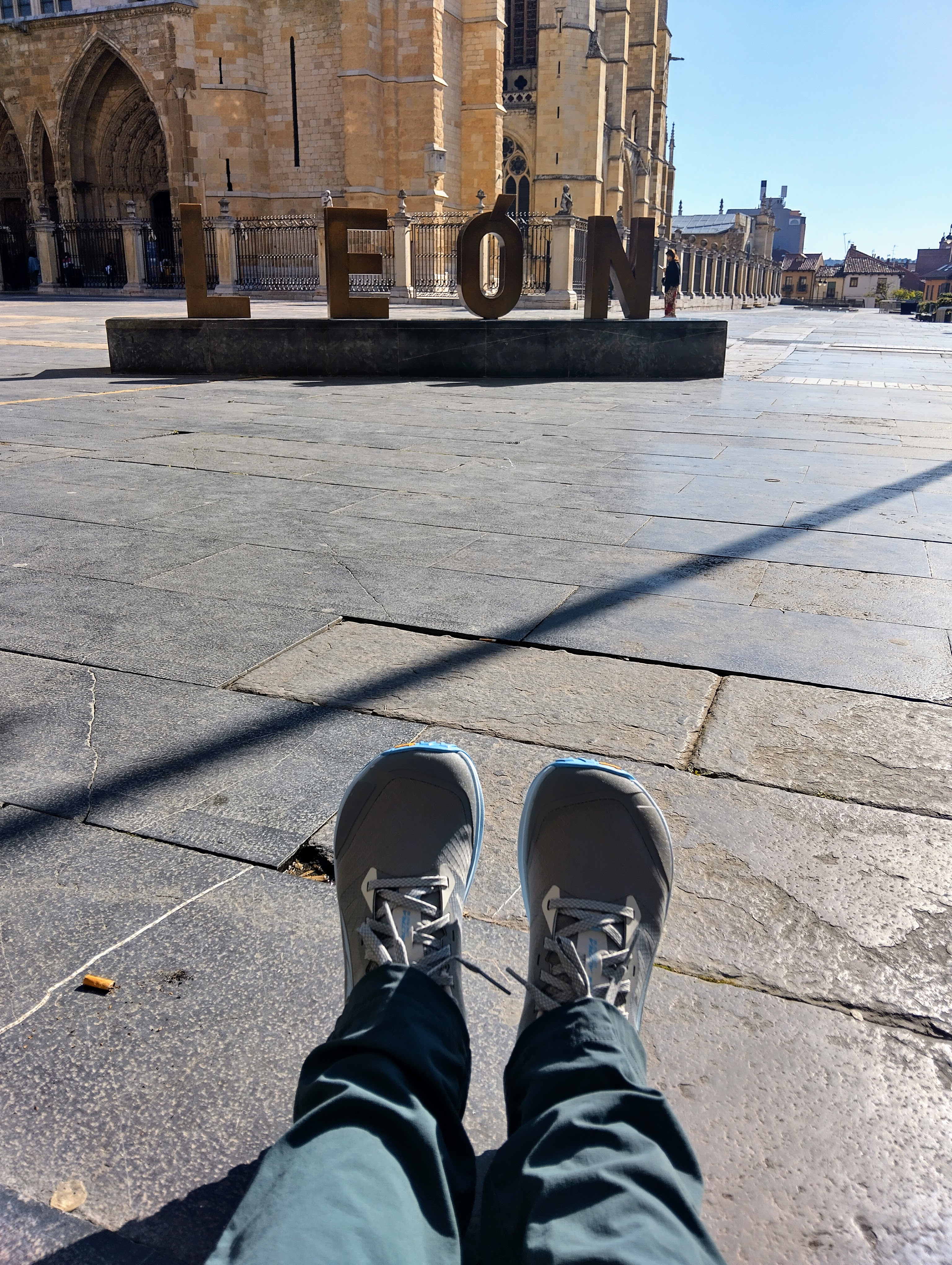
    Victoria Castillo in León on the Camino de Santiago.

    Then I checked into the Globetrotters hostel. Pod beds with curtains and real sheets in an all female dorm, plus a laundry service—the height of luxury for a pilgrim like me. The shower was nice; still not enough hooks, but plenty of little stools to put things on instead. Some chatty American ladies were in my dorm. One of them also used to be an aerospace engineer in the 80s but switched to biology.

    Once I was clean and my laundry was submitted to the front desk, I ventured back out to bask in civilization. Plenty of friends and acquaintances were in the area. I talked to Derf from Arizona (I think, definitely the US anyway). Derf’s name was passed down through his family and he always thought it was German until he came to Europe and was corrected by all the Germans. Now he was beginning to suspect that it might just be “Fred” backwards. He said he was a Methodist pastor, but, if I understood correctly, only sometimes believes in God. I came away from the conversation feeling simultaneously better and more confused with the world as a whole.

    Directly across from the entrance to the cathedral I found many pilgrims enjoying the terrace service of what was to become my favorite restaurant on the Camino, Loco León. (I had to look up the name because at the time everyone just referred to it as “the restaurant across from the cathedral”.) The Aussie nurses were there having a chicken and raspberry salad which I immediately knew I wanted to order. My new shoes were cause for celebration. Lori soon joined us and busily went about finding sight seeing information. There was a tram tour of the area that looked like a good way to see more of the city without walking. We agreed to meet for the tour at 4:00. That gave me some time to pick up my laundry and compare notes with Hemingway on the weather in this region.

    On the way down to the tour, I briefly ran into Michelle who had been spending some time with Julia and reported that there was no need to worry about her anymore, she was living her best Camino life on her own terms. Michelle planned to walk the next day and it would be a little while before we saw each other again.

    The timing of the tram tour was inconceivably lucky. It started raining right when I climbed aboard and stopped exactly one hour later as the tram pulled to a stop. The tour itself was worth the €5; it took us past all the historically significant buildings and other structures in the area, most of which I wouldn’t have walked all the way over to see.

    The news that Victoria got new shoes seemed to be spreading ahead of me and I spent the evening bouncing around showing them off. I felt acutely aware that I must seem like the most pathetic little pilgrim, but I at least I was still going. I had dinner at the same restaurant, inside this time and enjoyed the great vibe and eclectic décor.

    After a day of easily finding everything I needed, enjoying great food, conversation, and even weather that cooperated with my schedule, León was close in the running (next to Pamplona) for my favorite city on the Camino.

    Back at Globetrotters, when I was getting ready for bed, I found myself listening to the inspiring story of a lovely woman from England. She had gotten a bad ear infection that had completely derailed her Camino, forcing her to go home early. But she wasn’t upset or complaining. She had a good attitude and talked about how the situation had put her on a different journey than the one she was expecting. More than anything else she was incredibly grateful for her experience. I hoped I hadn’t complained too much about my problems and resolved to have a better outlook from then on.

    I enjoyed a restful night’s sleep despite the sounds of partying outside that lasted through the night.

    Day 27: León

    Since I was staying in a hostel, not an albergue, there was no worrying about checking out by 8 am or having to find somewhere else to stay for a second night. I even got to keep my bed and leave my stuff right where it was—truly a luxurious start to my “rest day”. By now I and the other first-time pilgrims had figured out that we did exactly as much walking in the cities on our “rest days” than we did on a regular walking day, and today was no exception.

    I planned to at least see the cathedral and the Gaudi museum. As per Spanish protocol, nothing but cafés were open before 10 am, so I killed the time with a leisurely breakfast at the ice cream parlor. After that I started with the Gaudi museum. I hadn’t known anything about Gaudi before then, but the museum was excellent and I spent over two hours there and came out inspired to go to Barcelona and see more of his designs. There was also a temporary exhibit in one of the rooms of Salvador Dali drawings depicting the circles of Hell from Dante’s Inferno, which I found really cool.

    Victoria Castillo in front of León Cathedral on the Camino de Santiago.
    Here’s the cathedral at a jaunty angle.

    Next was the cathedral, the poor, pathetic, ugly León Cathedral, if (admittedly exaggerated) public opinion was to be believed. Almost everyone I talked to ragged on it pretty harshly in my opinion, comparing it to the complexities of Burgos and complaining about the restoration scaffolding inside which blocked some of the view. The emphasis here was on the stained glass rather than the intricate carvings and altars. I imagined the builders working for decades on this structure, intended to inspire awe, only to have it dismissed as not worth spending a few euros to see. Ouch. Evidently the kryptonite of awe is expectation. I’m by no means a cathedral expert or even enthusiast, but I thought the stained glass was worth seeing, and sat watching the light shine through it until they closed for siesta time.

    Siesta time feels like about half an eternity when you aren’t sleeping through it. I sat in the plaza for a long time and watched the children get out of school, waiting for pilgrims to arrive and feeling terribly lonely. Eventually Sarah found me and cheered me up. She and I have a few things in common: we’re about the same age and she also quit her engineering job a few years ago to travel. I told her that even though I was having a lot of trouble with my feet—I tried my best not to complain—anything was better than giving up and going home.

    We went for drinks with her family and we were joined by Kim Kimmy, Lori, and Eliot. Fiona and Evannah came into town late, tired and in desperate need of ice cream. Just like that, I was surrounded by friends again. How easy it was to forget that they were almost always close by.

    For dinner Lori, Kim Kimmy, Noriko, and I sampled all the burgers on the menu at Loco León. Noriko declared hers to be the best burger she had ever had. Lori was of the opinion that this restaurant also had the best bathroom on the Camino; we took turns going in to admire it and were not disappointed.
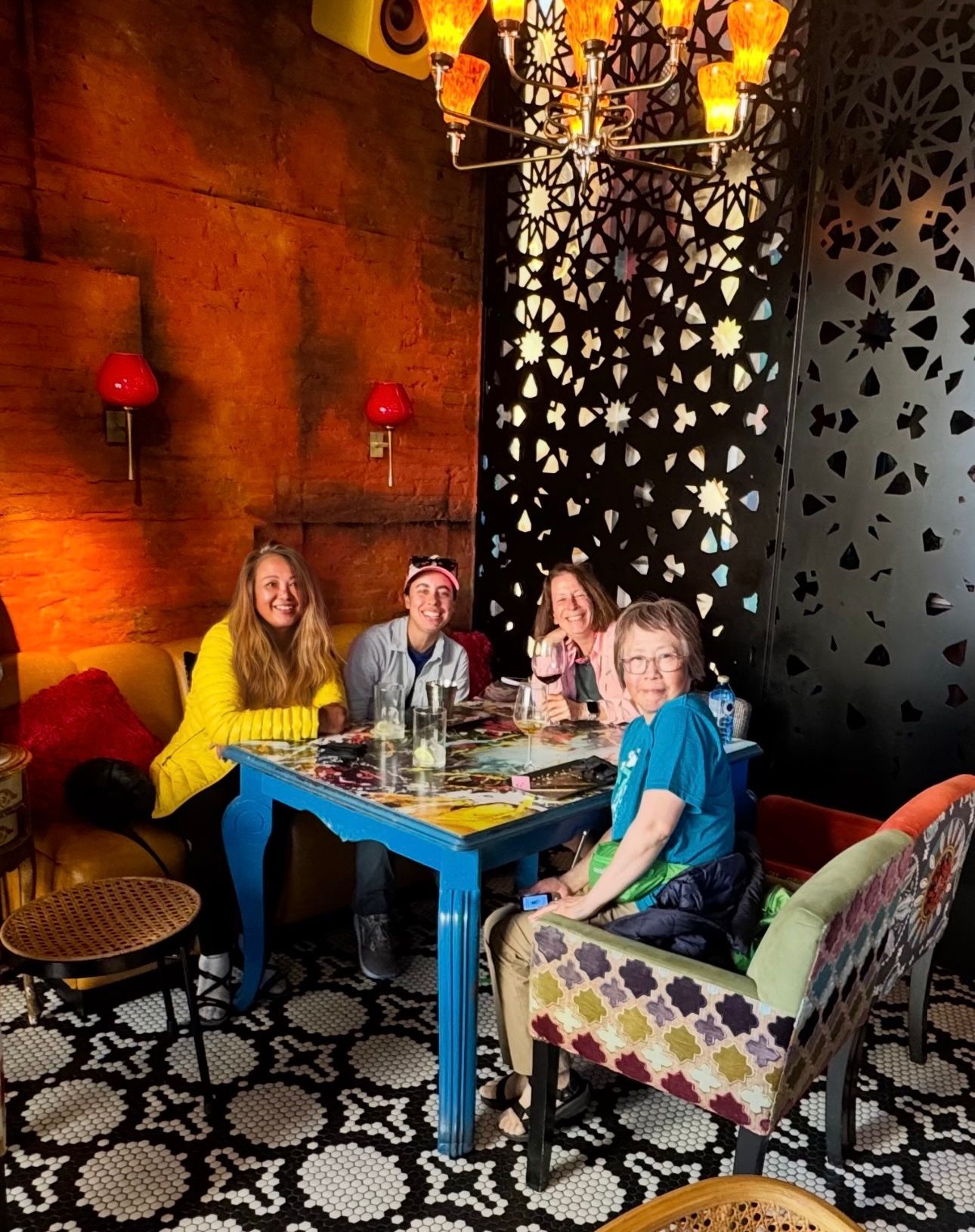
    Victoria Castillo and friends in León on the Camino de Santiago.
    Kim Kimmy, me, Lori, Noriko

    We were all staying at Globetrotters and we went to bed to the sound of increasing partying outside. This city seemed to be very popular for bachelor parties. I had a good time, but I was ready to walk again and confident that, with my new shoes, it would be a breeze from this point on. Some of you with good memories may be wondering why I hadn’t picked up some trekking poles as well. It was partly because I thought better shoes would be enough, and partly because, since I had been in the city and hadn’t seen anyone walking with poles, I completely forgot they existed.

  • Camino de Santiago: Days 16-19: Villambistia to Castrojeriz

    Day 16: Villambistia → Burgos (43.12 km)

    In the morning, my feet still stubbornly refused to go on. I looked up the timetable for the bus and hobbled across the road to wait, accompanied by a Kiwi named Barry. The bus stop was an abandoned, disintegrating booth covered in graffiti. Half an hour after the scheduled pickup time, we were on the verge of maybe, possibly, considering giving up and walking the 1.5 km to the next town, when the bus finally arrived. I bought myself a ticket to Burgos, the next major city, because I couldn’t risk ending up somewhere that didn’t have a pharmacy. As bad as I was hurting, two things instantly made me feel a lot better: several friends got on the bus in the next town, and it rained. Thus all FOMO was obliterated, and I felt no sense of loss for those 43 km.

    In Burgos, we picked up some maps at the tourist office, took pictures outside of the magnificent cathedral, then looked for our respective albergues, hostels, and hotels. (I think Geraldine, Carrie, and Michelle were there but no one can find the group photo.)

    Victoria Castillo in front of Burgos Cathedral on the Camino de Santiago.

    I put my backpack in the queue for the municipal albergue, and we met up for breakfast in the café across the street while waiting for check-in time. It ended up being one of the nicest municipal albergues I stayed in, with cubby-like bunkbeds that gave a little more privacy and blocked a lot of noise. Each little block even had its own sink. My bunkmate was a nice lady with a comforting presence named Foster, originally from Australia, now living in London.

    Next stop was the pharmacy, where they told me nothing could be done for my blisters other than prevent infection and rest. In other words, no walking tomorrow either. I bought some antiseptic and walked back to the albergue in tears to hand-wash my underwear. C’est la vie! Foster caught me crying and was very sympathetic.

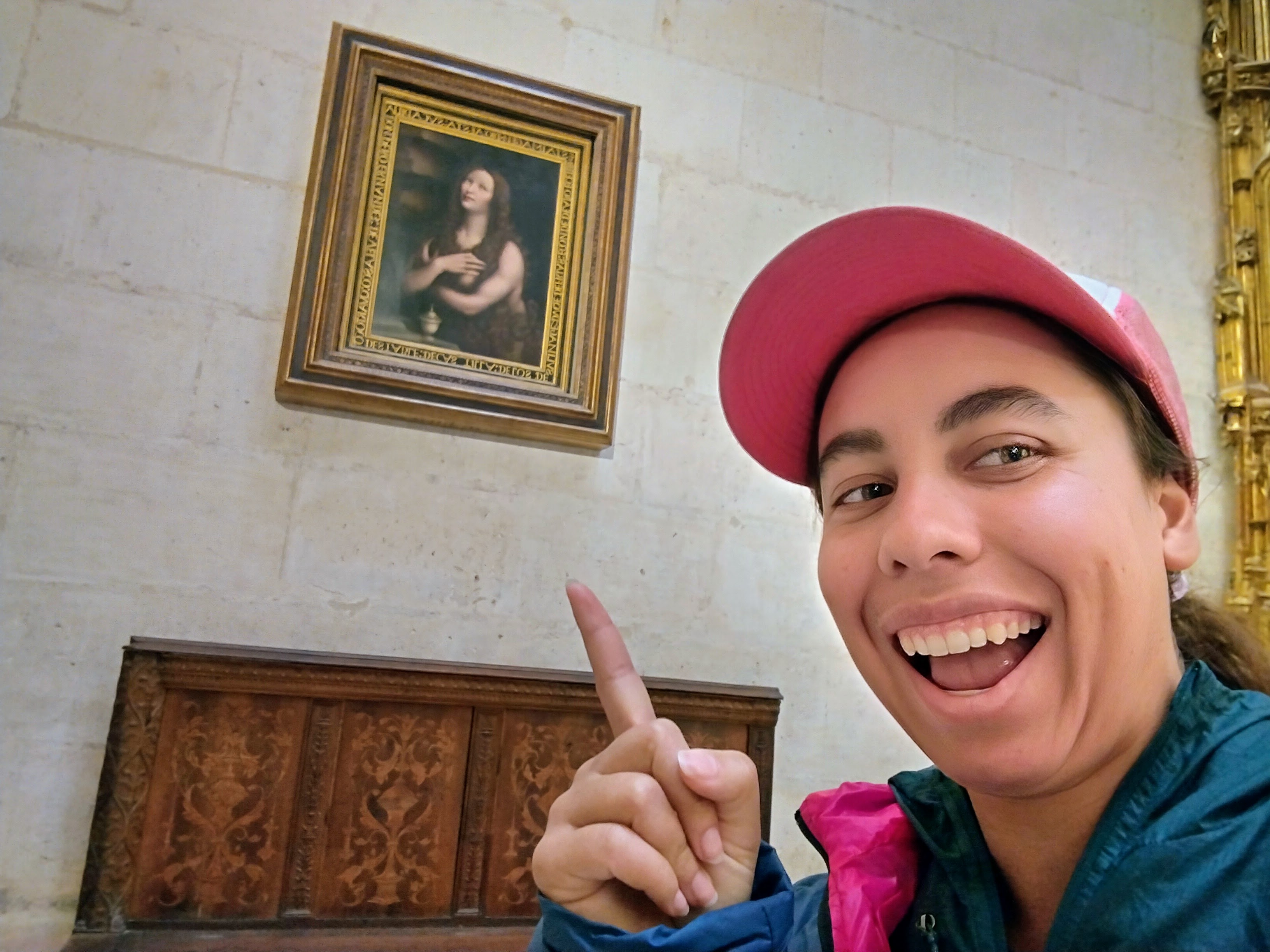
    Blisters or no blisters, the cathedral was too tempting to resist. I spent several hours hobbling from bench to bench to sit and admire the intricate stonework, carvings, paintings, and various gold thingamajigs (I believe that’s the technical term). Eunseok eventually found me there. We’d seen a lot of cathedrals together at this point, and were starting to identify some common trends, but this one went above and beyond. He remarked, “Why do rich people love tiny dogs?” vis-à-vis the many crypts of royalty with dogs at their feet. The highlights for me were Leonardo da Vinci’s Santa María Magdalena, cowgirl angel, and monkey with a shotgun.

    Victoria Castillo in Burgos Cathedral on the Camino de Santiago.
    Left: Santa María Magdalena by Leonardo da Vinci, Right: A huge dork.
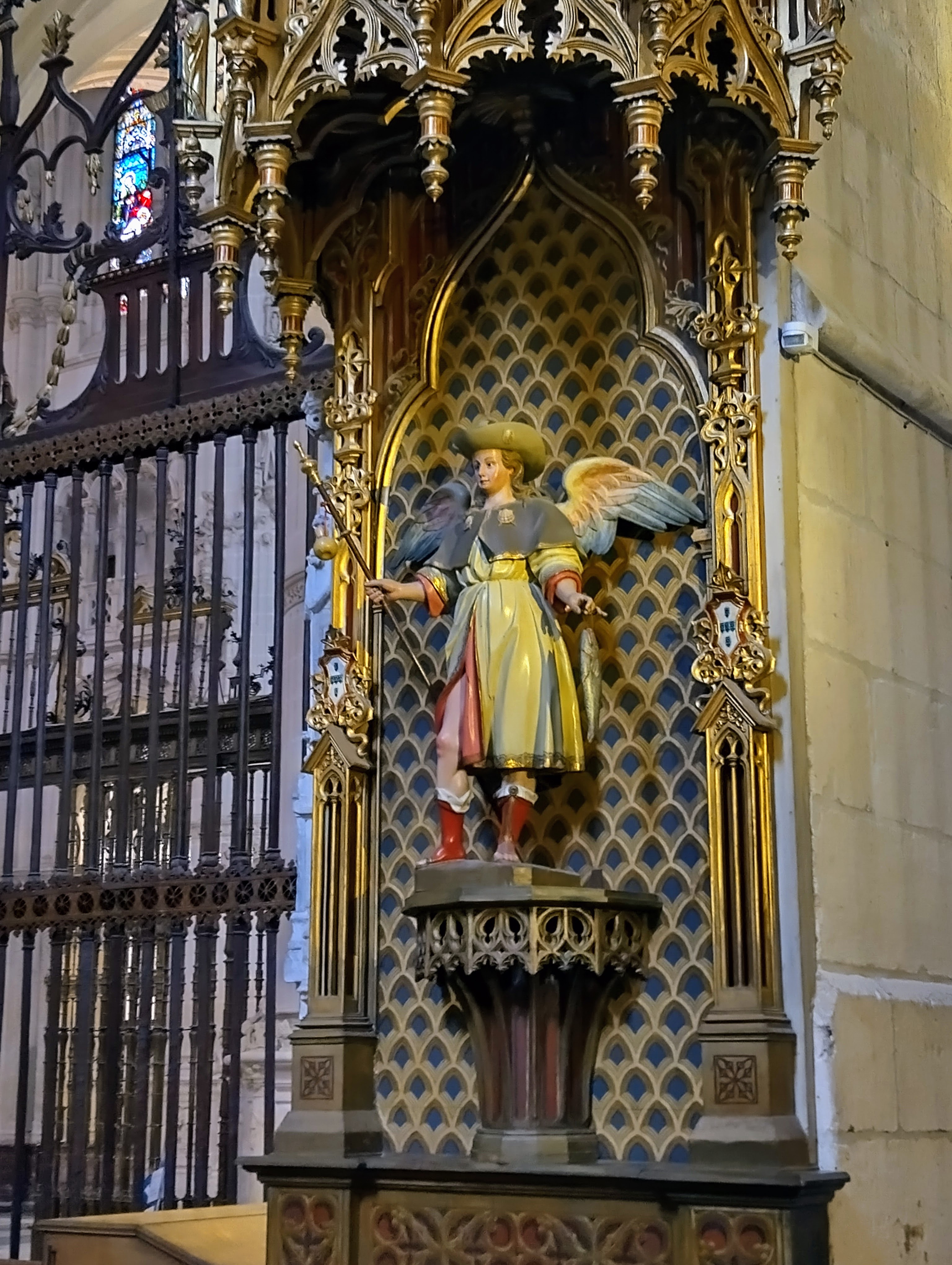
    I’m sure there’s a story to this, but I see a cowgirl angel returning from a fishing trip.
    Shotgun in one hand, flask in the other. (Thanks to Geraldine for a better photo than the one I took.)

    More friends arrived throughout the day. One of those friends was Julia. I’ve alluded to her only a couple times in this blog so far, but these minor mentions do not reflect the larger presence she had in my thoughts. She was the pilgrim who came alone instead of with her husband because he had passed away; she was the pilgrim who I lit a candle for in Estella; she was the pilgrim the encouraging messages were sent to. Her introduction at Orisson had hit me like a barbed arrow that wouldn’t come out, and even though we didn’t spend much time together, it felt very important to me for her to have a good Camino. The last time I had seen her was in the Pyrenees when she enlightened us that some little structures we kept seeing were for storing hay—she grew up on a dairy farm, if I remember correctly. I thought about her often as I walked and felt instinctively that she needed some help. Luckily, Kim Kimmy had done what I’d failed to and gotten her number. We added her to the group chat when I was back in Estella. She had been struggling a little further behind most of us and almost decided to go home, but here in Burgos, an oasis of white towels and bathtubs, she sent a message saying that “life is wonderful”.

    Plans for everyone to meet for dinner were made and cancelled due to exhaustion (Troy had walked 38 km!), illness (a nasty cough was going around), and preferring a warm shower to going outside in the cold (duh). All totally understandable, and reinforced my perspective that not making plans at all is the best way to go.

    Dinner ended up being just me and Kim Kimmy wedged into the tight corner of an irregularly-shaped restaurant. We split black sausage and a complicated tortilla that inexplicably came in its separate component parts and talked about the Camino and life. One of the big topics was how people try to put you in boxes. It was something she and I had in common and a prevalent theme of my Camino. Often when I meet people—and you meet a lot of people on the Camino—I find that they try to figure me out, label me, or “put me in a box”. That’s only natural, of course. The problem is most people don’t fit into any one box. Race is an easy example, but this applies for many other things too. You’d be surprised how often people ask me where I’m from and refuse to accept the answer. Personally, I don’t think that is very polite. When I met some pilgrims with thick Korean accents who told me they were from Los Angeles, I didn’t say, “But where are you really from?”, I said, “I’m from San Diego. We’re neighbors!” The thing is, people who reject the answer to “where are you from?” aren’t really asking that. What they really want to know is, “why do you look like that?” What a question! No wonder no one has the audacity to ask it directly. Kim Kimmy had the same kind of experience, being born in one country, raised in another, and now living in third. She dubbed me her “Camino daughter” and gave me much needed life advice.

    With a lot to think about, I retired to the municipal and squirted an excessive amount of antiseptic on my feet. It was a cold night. I was fine in my sleeping bag, but Foster only had a liner. I loaned her my puffy jacket to sleep in.

    Day 17: Burgos

    Evidently the puffy jacket was sufficiently warm because Foster was practically in hibernation throughout the morning while I got the rest of my things together. She was injury free and walking that day. After she left, I found my Dutch friend in the kitchen. She was sick and needed a rest day too, so we went to the front desk and begged for permission to stay a second night in the municipal, citing the pharmacist’s advice that I not walk. They assented as long as we waited a couple of hours after the regular check-in time, which I thought kind of asinine on account of there being more beds than they could possibly fill on a cold, rainy weekday (at least I assumed it was a weekday). Nevertheless, I waited.

    And what is the best way to wait when it’s cold and raining and you aren’t supposed to use your feet? You guessed it: sit in a café and blow half your budget on Colacao. Meanwhile, I aired my toes in the cold until they were numb, and then aired them some more.

    And I ruminated. I guess I was getting a head start on the mental challenge of the meseta. I second-guessed every major life decision I’d made since my quarter-life crisis began almost three years ago. Some of them I would have reversed in that moment if the opportunity had magically walked in the door. I really would have. Feeling cold, tired, and lonely will do that to your willpower. But those kinds of feelings are temporary, and somewhere inside, between my cold toes and my unwashed hair, the quintessence that is me remembered Oh, the Places You’ll Go! by Dr. Seuss and recognized the truth in it. I was in the waiting place.

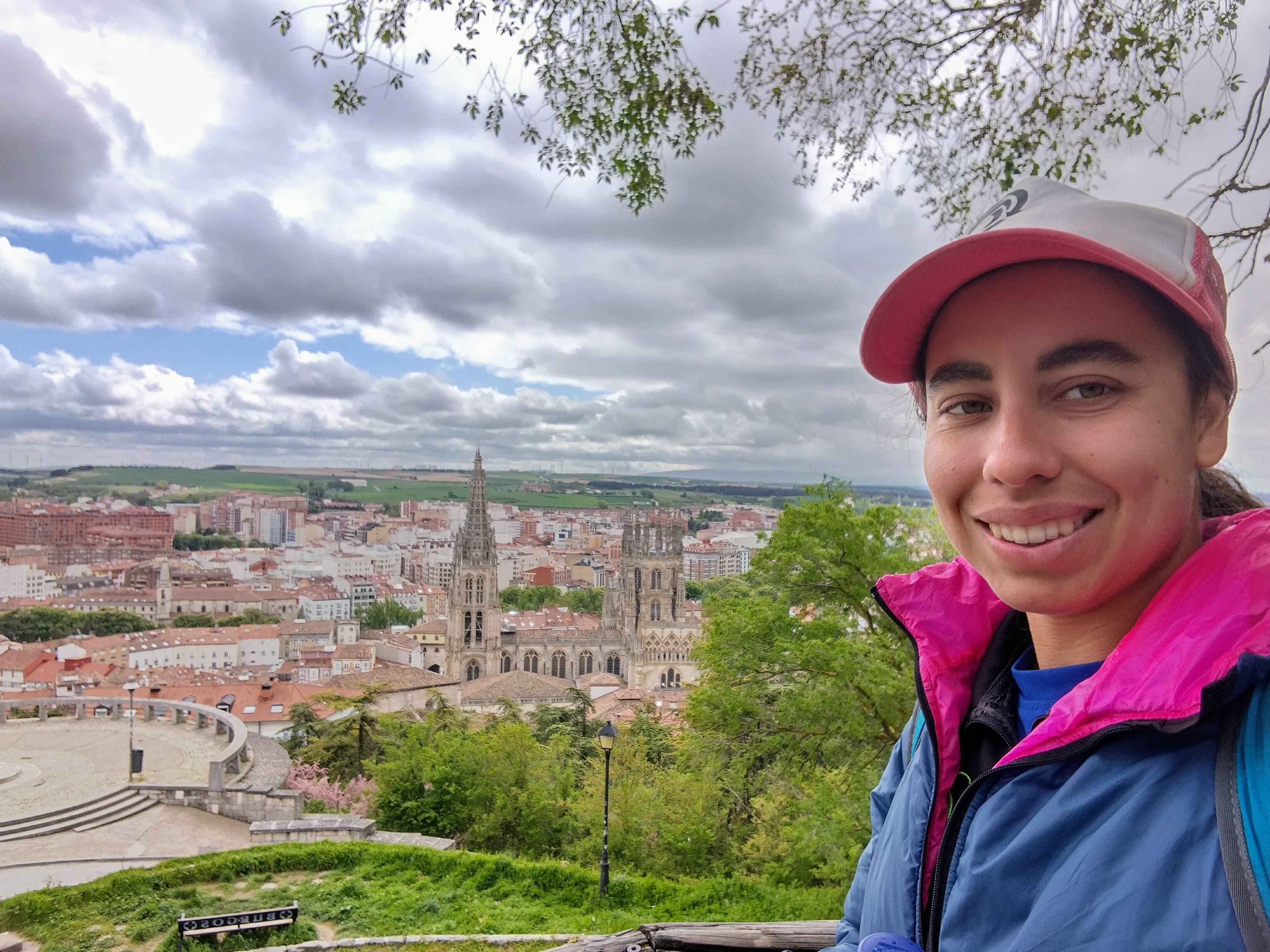
    No! That wasn’t for me! I knocked off waxing philosophical on children’s literature, got off my melancholy butt, and set off for new heights. Literally. I followed some signs that said “castillo” which led up too many stairs to a castle on the top of a hill. The castle itself was under construction and not worth photographing, but there was a great view of the city and cathedral from up there.

    Victoria Castillo in Burgos on the Camino de Santiago.

    That was as much activity as I could muster for the day. After an early dinner of croquettes that were too heavy for me to finish, I went straight to sleep.

    Day 18: Burgos → Hornillos del Camino (20.87 km)

    The city was silent in the morning in a way no city in America knows how to be. Only the pilgrims were outside to see the storks wake up on their tall, stone perches and feel the cold finally lift up to a comfortable temperature.

    I’d told myself I would walk a relatively short distance and not push myself too hard. In the next small town I stopped at a café/bar for the usual breakfast items and a bocadillo para llevar. Before the edge of town I stopped to rest on some steps with Carrie. She had a reservation at a nice albergue there. Despite the temptation to join her and what I had told myself about taking it easy that day, it was still early and I was itching to keep going.

    Just up the road there was a small church. I probably would have passed by it if there hadn’t been a line of pilgrims out the door. Curious to know what was going on, I asked a pilgrim who was just leaving. There was a nun stamping pilgrim passports and giving blessings. I got in line. Where else can you have this kind of experience? It was not a fast-moving line. The nun did not merely bless and stamp in an assembly line fashion; she was not there to reach a quota. She took the time to speak to each and every pilgrim individually. She was a wizened, elderly nun, who reminded me of my late abuela (grandmother) and was so tiny that she had to reach up to put her hand on my head—and I’m only 5 feet (152 cm) tall. When it was my turn she looked into my eyes and asked me (in Spanish) my name, and I told her in my best Castilian accent. She complimented the way I said it and we talked for a couple of minutes. One of the things she told me was that I am very young and therefore have a longer way to walk. I think she was talking more about the pilgrimage of life than the road to Santiago. I’m not really so young as all that, but perhaps my soul is and she could see it. She had an air about her that I don’t know how to put into words. Even now, I cannot seem to think, or talk, or write about her without tearing up. I got the sense that she genuinely loved every single pilgrim. The little pendant she gave me—every pilgrim got the same one—was of the Virgin Mary. I tied it to my backpack where it hung for the rest of my Camino.

    Victoria Castillo on the Camino de Santiago.
    I didn’t mean for it to look like I’m holding up a tiny backpack.

    After that the terrain became highly reminiscent of the original Microsoft Windows default wallpaper.

    I actually took this photo. Doesn’t it look familiar?

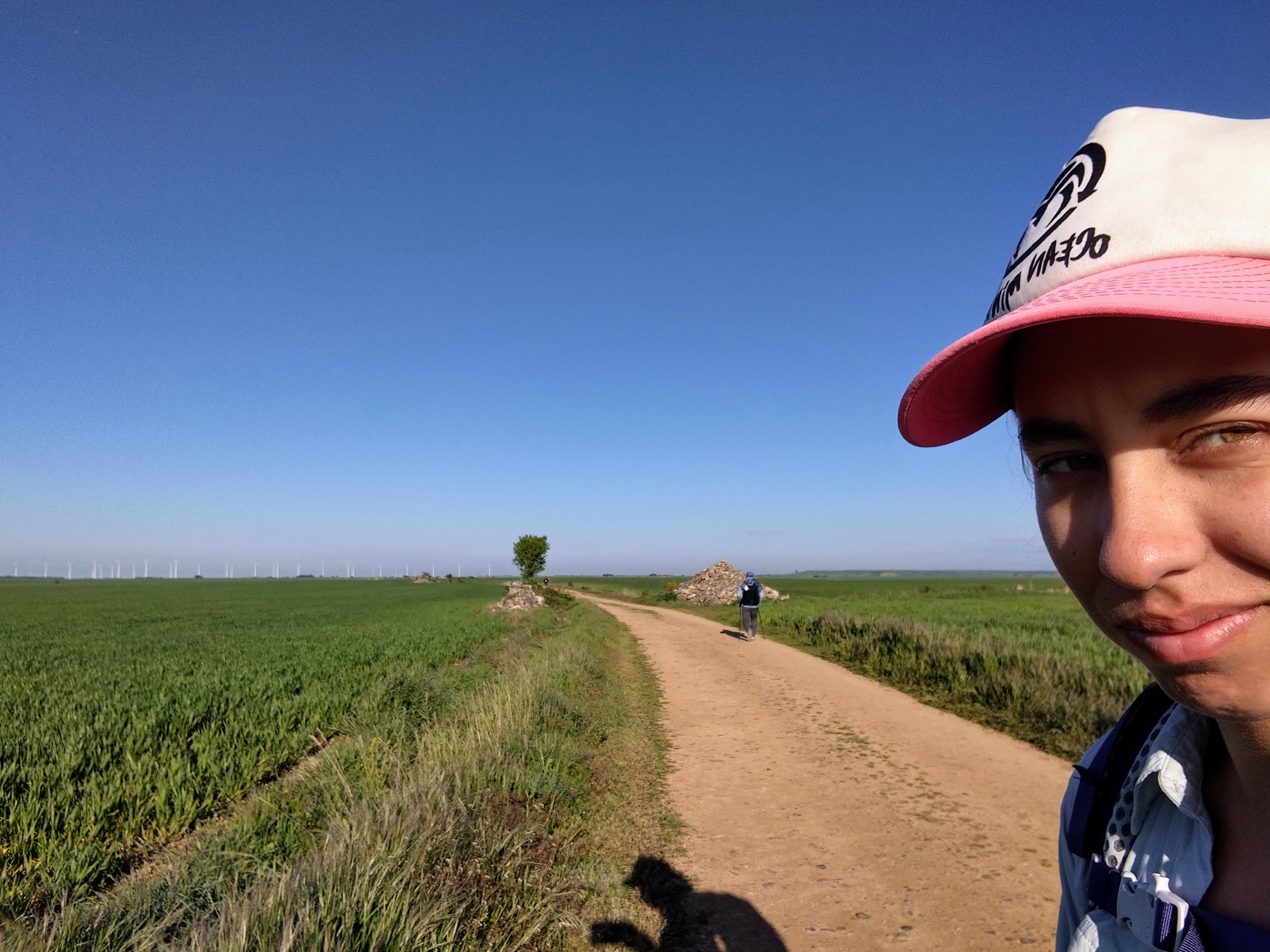
    Then it went completely flat with nothing but windmills in the distance, leading me to believe that I was already on the meseta. I stopped on the grassy side of the trail to attempt to mitigate the new blisters that were already forming on the bottom of my feet. Someone passing by was regaling a group with the story of the bus replacement from Bayonne to St. Jean. I called after them, “I was on the second bus!” They either didn’t hear me or didn’t care.

    Victoria Castillo on the Camino de Santiago.
    I call this one “Enthusiasm”.

    My final stopping place was Hornillos del Camino, twice as far from Burgos as I probably should have walked that day. I tiptoed through a cluster of cats into the municipal where I was assigned a top bunk as usual. While I was in the shower (3/10, co-ed, locking stall door, one hook, dirty floor), the ladder from my bunk mysteriously wandered off and was replaced with a wooden stool for me to use to climb up.

    The albergue was next to the church and across from a bar/restaurant that blared rock n’ roll music even through mass. Most pilgrims would have been happier if they’d served a communal dinner, but that wasn’t how they operated. They only had five small tables and every group had to put a name on a waiting list. None of my friends were around and I wasn’t in a social mood, so ended up being an awkward group of one. While I was enjoying a good steak and an even better ice cream sundae, I watched the busy waitress run back and forth. She was a Swiss girl who was trying to learn English and Spanish at the same time while everything in her head was in French. She was working so hard that I was determined to tell her she was doing a good job. That’s the kind of thing I often want to do and regretfully fail to follow through with. She was so busy that I nearly lost the opportunity, but on my way out I gave her a poke and told her, and she seemed so glad to hear it.

    The rest of the sunny evening—the daylight hours were getting longer and longer—I spent on the church terrace where most of the pilgrims staying in the municipal were hanging out. Word came through the group chat that Teresa and Archer had made it to Burgos and the end of their Camino. I missed them already. One of Teresa’s funny stories would have been great to hear right then. Feeling a little downcast, I chose to read rather than socialize and was slogging my way through Hemingway (not exactly uplifting literature), when there was a sudden commotion and two guys sprinted in the direction of the bar. I moved to where I could see what was going on. A pilgrim had collapsed in front of the bar. A lot of people were already helping and an ambulance was called, and there was nothing I could do other than get in the way, so I sat down on the steps to watch.

    While I sat there Thomas from Sweden came and talked to me. He’d noticed I seemed withdrawn and lonely. I kept trying not to cry, but couldn’t help it. He made me tell him what was wrong and I really tried. I awkwardly boiled it down to not knowing what to do with my life, difficulty defying the expectations of others, confusion over whether I’d made good decisions, and guilt over feeling sad when I’ve been lucky and had so many opportunities in life. He was sympathetic. This was his first Camino too and we talked about our impressions and expectations.

    Meanwhile, the collapsed pilgrim was lifted and propped up in a chair. The blood on his head was visible from where we sat about 50 feet (15 meters) away, but something else must have been wrong that caused him to fall in the first place. The responders commenced arguing what to do next.

    Thomas had a theory that people who do the Camino over and over again do so because they discover themselves or some sense of freedom on the Camino, but when they go back to their everyday life they don’t change anything. He literally called it going “back into the box”. So they have to come back to the Camino to find themselves again. At the time I thought this was probably true. But then I still had more than half of the way to go and a lot to learn.

    The loudest and most stressed responder won the argument, and the injured man was laid back down on the ground. The hospitalera who ran the municipal brought a pillow for his head.

    We contemplated the meseta and Thomas revealed the shocking truth that we weren’t on it yet. He predicted that the walk across the meseta would be a time when we would look inward and think without distractions and that I would discover who I am. I hoped so; although, at the moment it felt like the more likely scenario was that I would cry my way across it in confusion. Nevertheless, talking to someone helped. I resolved then to think outside of the box about what I really want from life and somehow find the courage to do it no matter what anyone else thinks. That is the hardest thing.

    An ambulance finally arrived and the professionals took over. Once they’d loaded the patient into the ambulance, it sat there for what felt like a long time and then drove off back towards Burgos. I never found out who the pilgrim was or what happened to him.

    As the sun finally started to admit that it was bedtime, I sidled my way past a volley of scraps that the hospitalera was flinging at the cats, up the wooden stool to my bunk, and into my sleeping bag.

    Day 19: Hornillos del Camino → Castrojeriz (19.47 km)

    To say I woke up with a positive attitude, ready to seize the day would be a preposterous lie. My eyes thought they smelled onions and didn’t show any sign of changing their mind. I snuck out before anyone could see me, weaving my way through the cats who had formed a militaristic pattern in the tiny foyer, presumably in preparation for an imminent invasion of the kitchen. I left intending to only walk about 10 km, but (spoiler alert) I ended up going 20 km again.

    Victoria Castillo on the Camino de Santiago.
    “Morning Mood”

    There was a lot of flat terrain again, but every time I thought I must finally be on the meseta, a hill or valley would appear around the bend, and the cuckoo bird would utter its mocking chime.

    One of the many pilgrims who passed me that day—I passed no one—was the Spaniard whose backpack had weighed 22 kg in Pamplona. He recognized me and asked about the “Korean guy with the new stuff who didn’t know anything.” I had to admit that I hadn’t seen him at all. As the good-natured Spaniard continued on at a pace I would have had to run to keep up with, he looked back at me and smiled. I was surprised how much I felt cheered up. Then I noticed that he carried only a small day pack and almost laughed.

    Later, when I’d just finished airing my feet for the fourth time, Sarah, Emma, Andrew, and Gillian caught up to me. They were cheerful as usual. Sarah chatted with me for a little while about our surroundings. She’d drawn the Microsoft Windows connection too and thought it was pretty. I found the flat bits a little too reminiscent of Oklahoma for my taste. Landscape snobbery aside, Sarah’s smile and the unbreakable good humor of the entire family cheered me up even more.

    Somewhere in the middle of the boundless green desert was a café oasis where everyone who’d passed me (so it seemed) was eating and relaxing on the patio. As I staggered up to it with fantasies of orange juice and pastries swirling before my eyes, I was suddenly and swiftly pounced upon by what, at the time, I called a “gaggle” but have since considered to be a “pack” of Aussie nurses who ardently forced their care upon me and refused to take no for an answer. They ordered me into a chair, removed my boots, applied patches of useless Compeed, chastised me for insufficient use of Vaseline, slathered more on my feet themselves, then bought me a glass of zumo de naranja (for which I was truly thankful), and dosed me with 1 g of Paracetamol (Tylenol), the only available painkiller which I’m not allergic to. All the while they vehemently argued with Eliot, a retired Scottish soldier who leads expeditions around the world, about footcare and the proper way to pack a backpack. I think he was actually right about everything, but I dared not go against them for fear of disparaging their profession. If this was their care, I certainly didn’t want to incite their wrath. Then, as quickly as the onslaught had begun, they got up and left, along with almost everyone else. I sat there stunned for a minute or two, with my four cheerful friends as the only remaining witnesses. I wanted to go inside and order more food and get a stamp, but I didn’t. In a daze, I got up and continued walking.

    Less than a kilometer down the trail was Hontanas, the town I planned to stop in. It was cute and there were several nice looking albergues/hostels to choose from, including one with a spa. But the painkillers had just kicked in, so against the better judgment of everyone else, I kept walking.

    Almost there!

    There is a lot to be said for the belief in fate, or that everything happens for a reason, or that you should trust your instincts to take you where you’re meant to be. The path beyond that town where I might have stopped finally induced me to admit that the landscape was beautiful. There were fields of grain that looked almost like soft fur that I wanted to pet, and the breeze rippled its surface like water. I came to a part of the path where I could reach the grain and run my hand over it. It did not disappoint. It really did feel like soft fur. As I was enjoying this sensation, I looked up and saw Foster coming up the trail. She had walked as far as she had time for and was walking back to Burgos to make her way home to London. She said she’d had a feeling she would see me again. If I had stopped earlier, we probably would have missed each other.

    Victoria Castillo and friend on the Camino de Santiago.
    Foster and me by the soft grain.

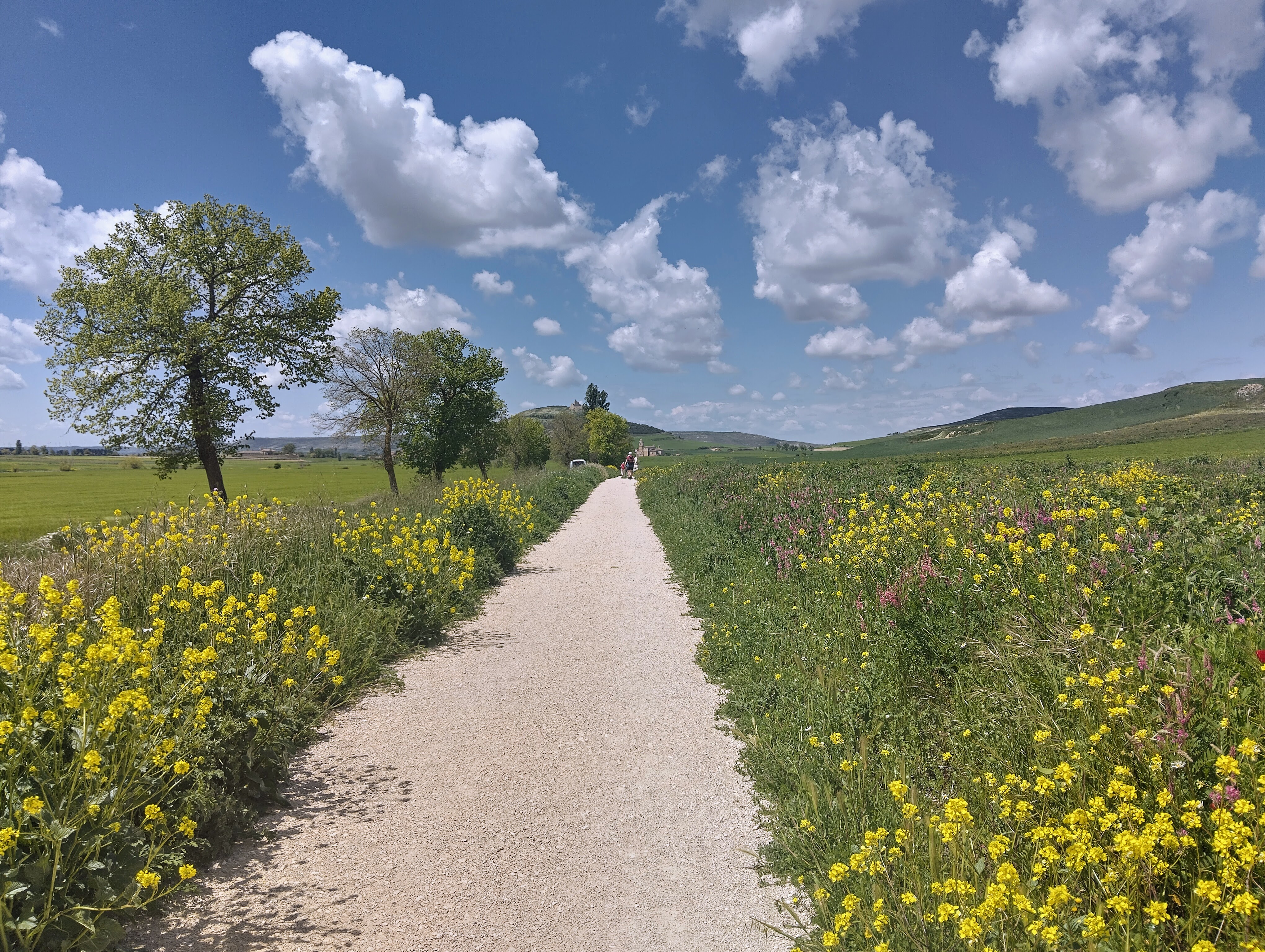
    Approaching Castrojeriz, the trail passed through some ruins into more rippling fields lined with flowers.

    Victoria Castillo on the Camino de Santiago.

    The town itself abutted a hill topped with a ruined castle that loomed triumphantly over the rest of the land. I limped along the cobblestone street expecting to end up in another shabby municipal albergue, when a miracle occurred. I got too tired to continue (that’s not a miracle), so I took a chance and looked into the nearest albergue, which happened to be Albergue Ultreia. It ended up being one of my favorite places I stayed on the Camino. Not only did the owner graciously welcome me in, he gave me a single bed and I didn’t even have to beg or lay siege to it. I took a shower (clean, but still not enough hooks), then hand-washed my laundry to the tune of the serenade of an old Italian pilgrim. And I got my spa experience after all in the refreshingly cold foot soaking tub they had in the rooftop garden.

    Victoria Castillo in Albergue Ultreia on the Camino de Santiago.
    Heaven is cold water when your feet hurt.

    The pilgrim dinner at Ultreia was the most fun I’d had in days. We were a party of two French, two Germans, two Italians, two Americans (including me), and a Kiwi named Dudley Moore. The food was the usual three courses: vegetable soup and bread, chicken, wine and homemade sangria to drink, and ice cream for dessert. But the real treat was the after-dinner tour of the ancient wine cellar underneath the albergue. Our illustrious guide (the owner) related the history of the place, translating all the important nouns into every language represented and making many “oohs” and “aahs” which we of course echoed through giggles. He let us turn the wine press, then we went down into the cellar where he lit and passed around some twelfth century oil lamps and showed us the old tunnels that used to lead all the way up to the castle. The tour concluded with a tasting of the wine and a toast.

    Pretending the press is full of grapes and difficult to turn.
    Victoria Castillo on the Camino de Santiago.
    The old tunnel leading up to the castle.

    As we got ready for bed, someone got the news that a new pope had been elected and was an American. This was a big surprise to everyone. I don’t know anything about how the pope is selected, but somehow I didn’t think an American would have been allowed. Silly, I know.

    My new Italian friends warned me that the real meseta would officially start tomorrow. Based on the foreboding attitude everyone seemed to have about it, I imagined a desolate wasteland resembling Mordor from The Lord of the Rings and mentally braced myself.